The Folk Hour on WHCL-FM
One Hamilton institution (albeit, a young one) that welcomed Kirkland women in 1968 was the broadcast station WHCL-FM (“88.7 on your FM dial”). Its studio was then located in the basement of Minor Theater, and it boasted an AP Newswire teletype (student staffers were expected to check for breaking news and to share any important reports).
The history of WHCL-FM is told (in brief) on its current website. In the late ’60s, the station was governed by a somewhat formal structure, which included a Program Director, show producers and on-air hosts. Per FCC (music licensing) regulations, all programs had to submit a playlist in advance of broadcast.
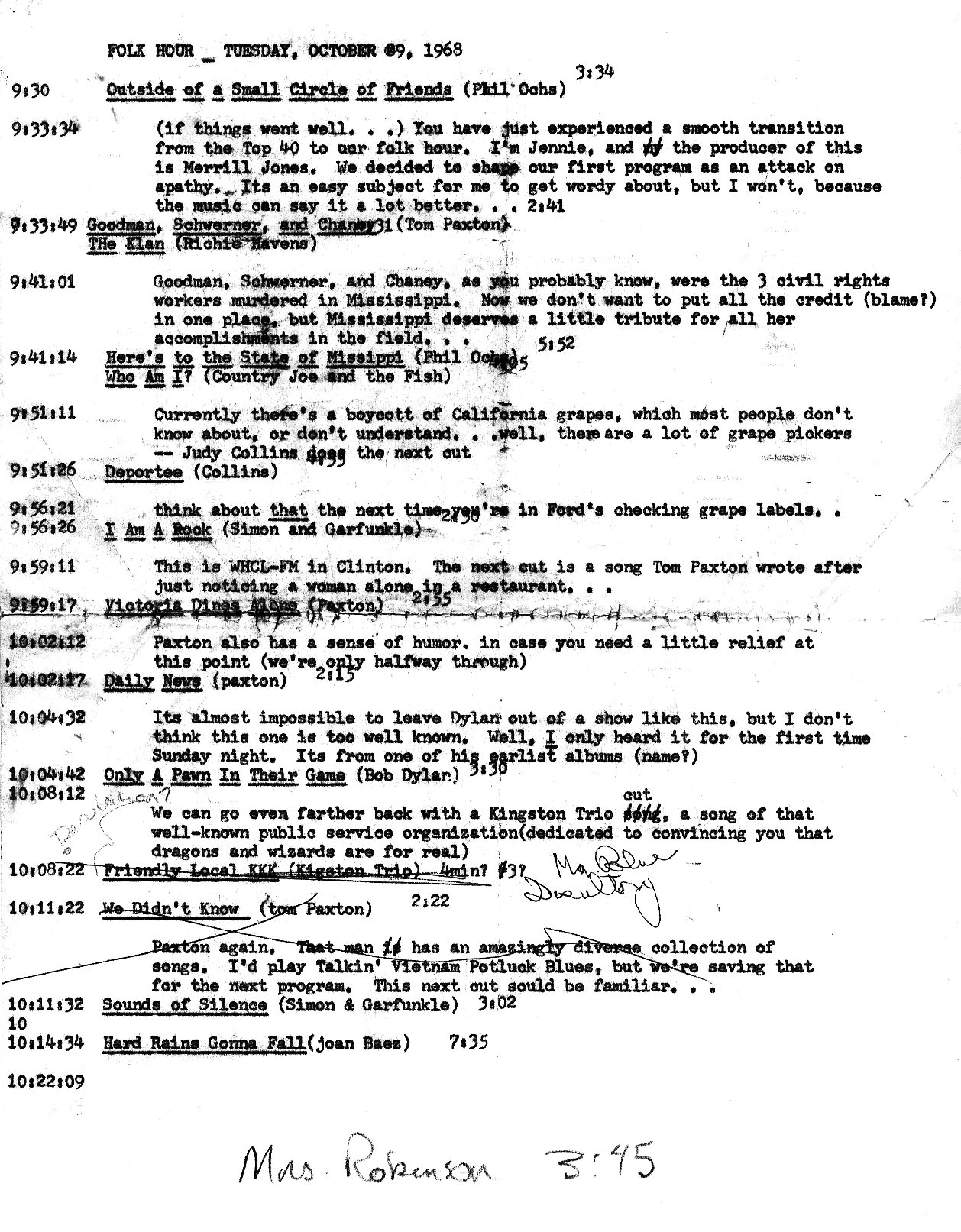
Playlist for the Folk Hour 1968
While I can’t recall all the details of how we got started, I know that show producer Merrill Jones (who passed away in 1979) took me on as an announcer. Together we worked on a playlist of contemporary folk (pre folk-rock) offerings and commentary. Within a year, I was producing live music broadcasts in cooperation with the Kirkland Coffee House (housed in a corner of McEwen, near the rock swing).
On November 6, 1969, 9:45pm-12mid, we broadcast “Grassroots” live Broadcast from the Kirkland Coffee House. Bob Shea was our engineer, and I kept a 1/4″ reel-to-reel magnetic tape from the program for 35 years. In 2005 I was able to digitize some selections.
This first selection is the most interesting to me, and may deserve some explanation.
Maggie Calt (K’72) guitar solo:
Maggie Calt is a niece of B.F. Skinner, one of Hamilton’s more renowned graduates. In the ’60s, her brother Steven started a roots music record label, well-regarded in its day, called Yazoo. Before entering Kirkland, Maggie met and learned from some Delta Blues greats (like Skip James and Bukka White) who were old men when Yazoo revived interest in them. So she brought a guitar style to Kirkland that was not informed (as mine was) by Peter, Paul and Mary . She introduced me to Robert Johnson, before his work became well-known through Rolling Stone covers.
Maggie was also a French scholar – I recall she did a paper on Robert Johnson and Existentialism – and left campus for France before our senior year. She later married a French citizen and lived in Africa, when he was stationed in Senegal, in the late ’70s. Based upon what I found via Google, Maggie still lives in France, working as a freelance translator.
The ’69 broadcast ended with a live (and somewhat over-extended) blues jam, with both Kirkland and Hamilton guitarists going at it to the best of their varying abilities!
H/K Guitar Jam (includes Maggie Calt K’72, Jennie Morris ’72, Richard Marcus H’72, John Mark Garrison H’072, Greg Ritz H’70, Jim Paisley, S. Bennett, and J. Bilser)
The third folk music audio is of me and a couple of friends – somewhat loosened up, but having fun – perhaps representative of how we entertained ourselves back in the day!
Kirkland Folkies in ’71: Jennie Morris, Sue Shyan Delahanty, Pat McLaughlin Amidon (all K’72)
by Jennie Morris K’72
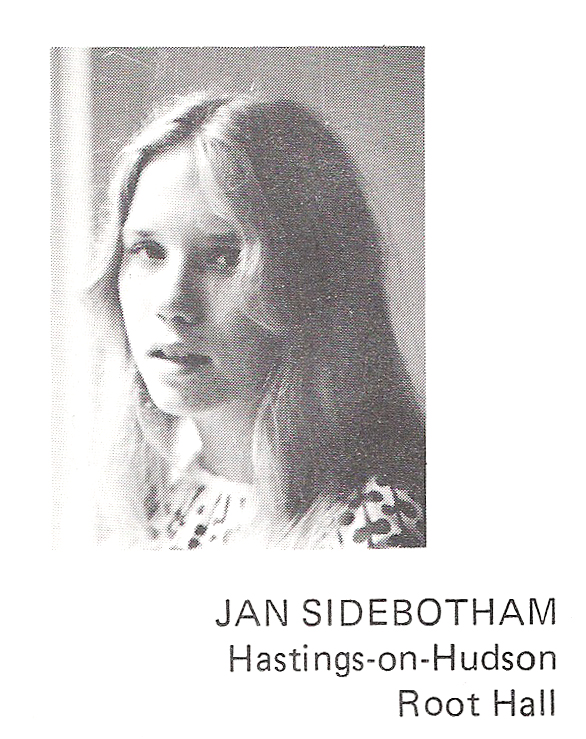
Jan Sidebotham, K'79, from the 1979 Funny Book
While writing a philosophy of education statement for work recently, I found myself facing lots of pronoun/antecedent issues.
Here’s what I mean: I’d write a sentence like, “Even if a child doesn’t like their [his] teacher, they [he] like[s] the experience of feeling safe and valued.”
The problem is that the sentence is grammatically incorrect because the antecedent – child – is singular. The pronoun should be singular, but our third-person singular pronouns are gender specific (he, she, his, her, etc.). That reminded me of the Kirkland College catalogue, and why words matter. The singular pronoun was always feminine.
“Every student should meet with her advisor to discuss her concentration requirements.”
I’d never read anything that used the singular pronoun that way. It had a subtle but powerful effect. That sentence, this catalogue – they were written for me! It made me think of the pervasive but somewhat ignored male dominance in my life. In every other context, that sentence would have read, “Every student should meet with his advisor to discuss his concentration requirements.” I would have understood that the pronoun he included me, but it included me as an afterthought, sort of like “Oh yeah, girls can play, too.”
At Kirkland, though, I wasn’t an afterthought. I was the targeted audience.
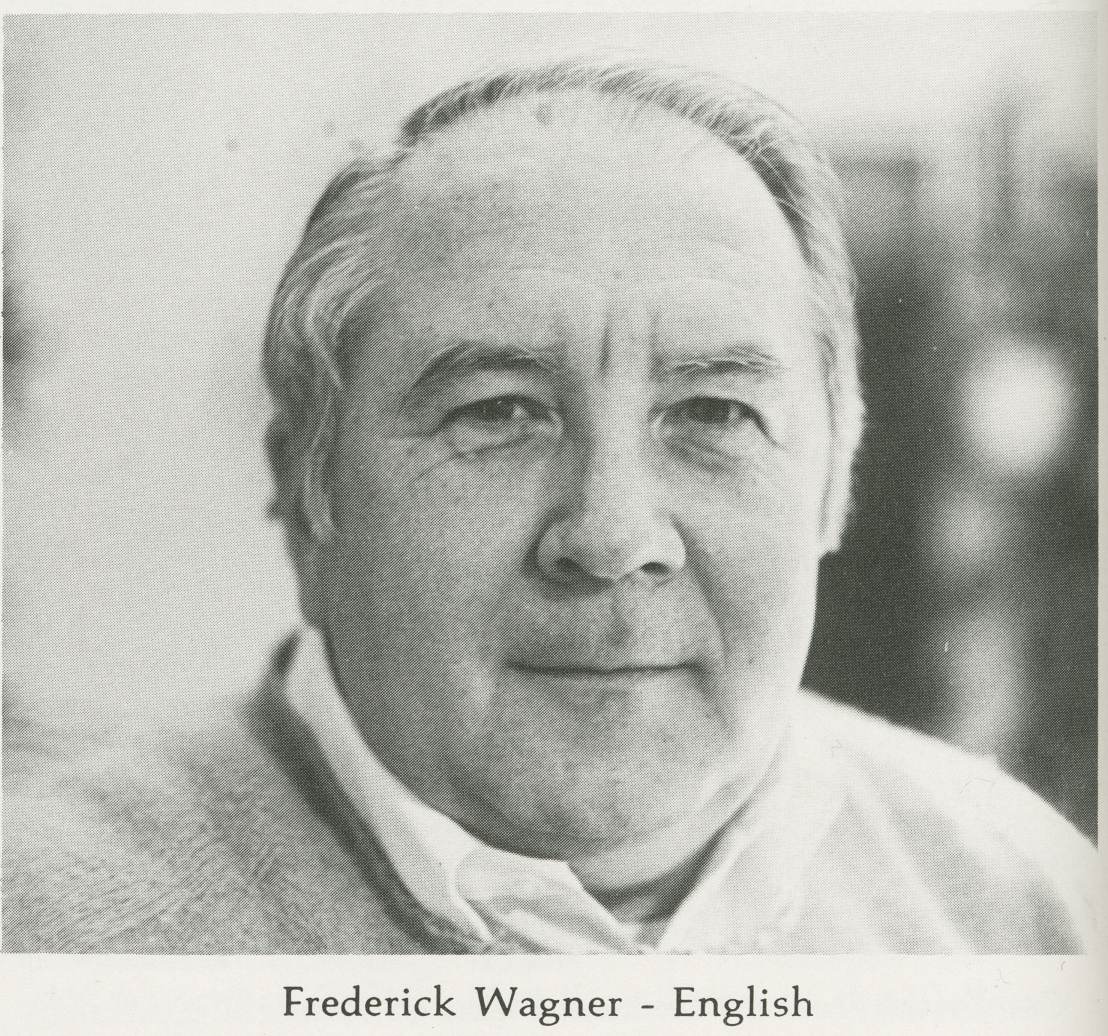
Professor Wagner, from the 1978 Roots in the Glen yearbook
The sense of importance this kind of thoughtful writing gave me was underscored by an experience I had in one of my Hamilton classes. I was taking Restoration Comedy with Fred Wagner (a wonderful person, by the way). We had taken one of those blue book tests; we’d had to write several essays. Before handing back the tests, Dr. Wagner said something like, “I want to read some of your classmates’ work to you, so you’ll know what a good essay is.” He didn’t tell us who had written the essays, but mine was one of them. When he finished reading each one, he’d ask the class, “Now what do you think is good about this essay?”
The only specific observation I remember is that someone thought it was thorough. What I remember most sharply is that there were several comments and each one referred to the anonymous writer (me) as he or him. It was sort of surreal to listen to people talk about me and my writing and refer to me as a man. There were three women in that class of 20, so maybe it makes sense that students would use the male pronoun. I still think that someone a little more observant might have said “he or she.”
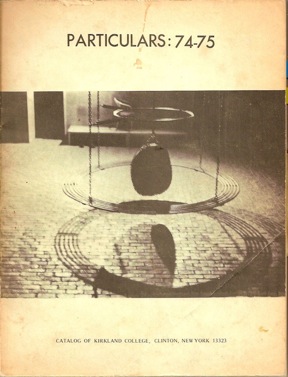
Kirkland's catalogue, in which the feminine personal pronoun was queen
As I look back, I’m keenly aware of the juxtaposition of my feelings. While Dr. Wagner’s choice of my essay made me feel good, my invisibility to my classmates made me feel . . . invisible.
I don’t include the anecdote about the English class to throw criticism at the other students. It’s just that women don’t often get the chance to feel so strikingly what the pervasive use of the masculine pronoun can do – make women somewhat invisible.
Every piece of writing the Kirkland institution produced — course catalogs, admissions and alumnae publications, flyers — used the feminine pronoun. As if I’d had a dose of vitamin D on a string of sunny days, I felt more immune to self-esteem issues in a world that didn’t always value women. Kirkland taught me that women — and words — matter.
Jan Sidebotham, K’79
A View from Across the Road
When Kirkland greeted its first students in 1968, few of those studying across the road suddenly thought of their school as a “coordinate college.” Very few, in fact, knew what to expect.
In 2009 Shelley Cowan K’75 had an opportunity to ask Hamilton’s Professor Jay Williams about his perspective on the Kirkland decade. Professor Williams was Chaplain and Professor of Religion during that time, and many Kirkland students enrolled in his classes. Click the triangle below to listen:
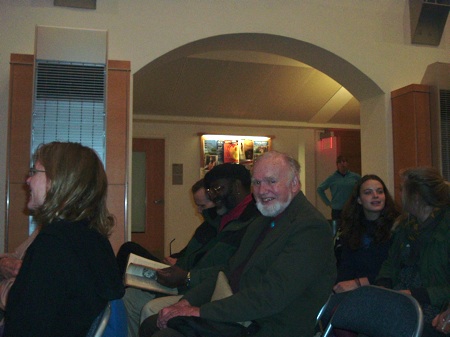
Prof. Williams listening to Kirkland poets Jo Pitkin and Nin Andrews in 2010
Not long after this was recorded, the H/K classes of 1975 held a joint reunion on the Hill. Peter Lotto contributed this summary of their recollections:
As part of our 2010 reunion celebration, Hamilton and Kirkland graduates from ‘75 gathered in Café Opus for an open-mic dialog about what it was like to have been part of “the middle years” of Kirkland-Hamilton. While Kirkland alumnae have had a number of opportunities to talk about their experiences, Hamilton alumni have not had many public discussions about the impact of Kirkland on their college years. We didn’t record the conversation; so if you were there, please correct my quotes and add whatever I missed. [Click here to read more]
Winter Recollections
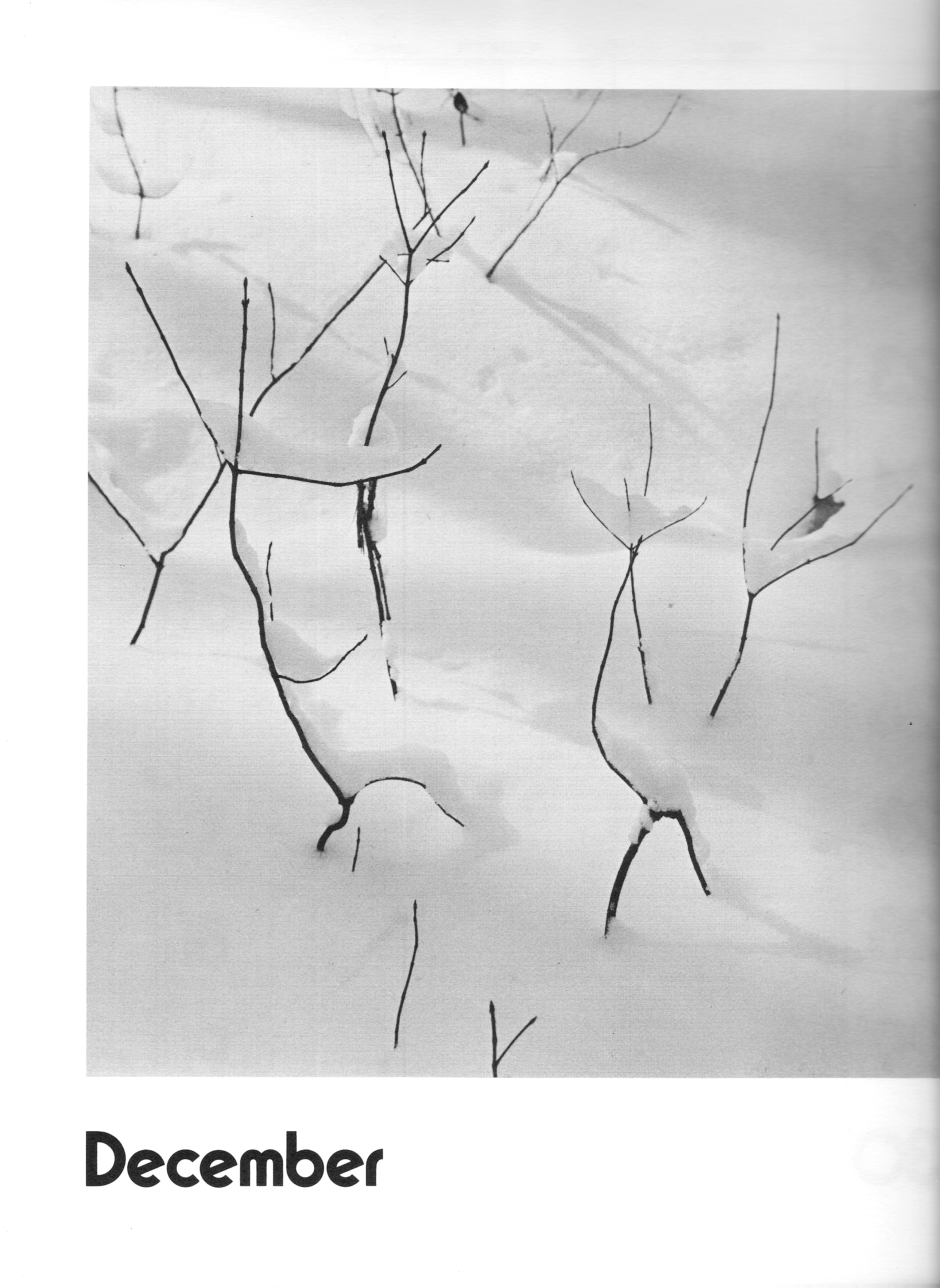
From Kirkland College 1974-1975 Calendar
Do you remember when it snowed in May in Clinton?
A few weeks ago, Archives, Media and Publications sent out an email hoping to spark alumni recollections of the long, long, long winter season on the Hill.
Pour yourself a steaming mug of herbal tea, toss another log on the fire, and join the conversation! Send us your own winter memories—and take a look at some of our classmates’ Winter Study reminiscences here and at http://www.storychip.com/jeanmcg:kirkland-college.
Here are some of the creative, inspiring, thoughtful, responses we have received thus far:
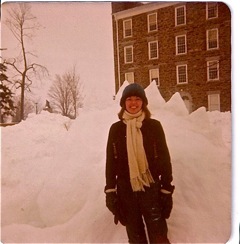
Snow on the quad, 1978
There was plenty of snow in the winter of my senior year at Kirkland, 1977-78.
January term found me finishing paintings for an independent study with Bill Salzillo and obsessing over my senior project with Esther Barrazone. It was a quiet, peaceful time and always beautiful. A visit from my boyfriend—now husband of 30 years—Ed Watkins H’74 helped break up the time.
Check out my photo of Ed and friend, Dick Usher, H’75, “riding a bike” in front of Milbank.
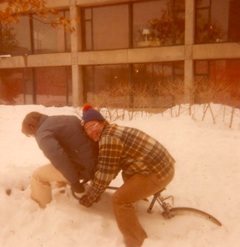
Hamiltonians "riding" a bike, winter '78
I lived in a Milbank suite with four wonderful women from the Class of 1982. Beth Baker and Lisa Master are pictured here with me in our suite.
Kirkland women through and through, they had to make the difficult decision of whether to stay and graduate from Hamilton or continue their education elsewhere.
Cathy Fahey, K’78
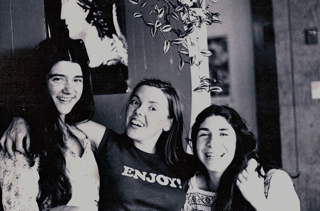 Suitemates Beth Baker '82, Cathy Fahey '78, Lisa Master '82 |
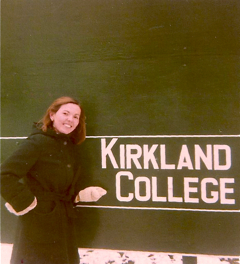 Entrance sign with Cathy Fahey '78 |
The wonderful photo image [from the Kirkland calendar; see above] I remember inspired a long hike then, this poem now.
Thanks for the chance to reflect.
Yrs,
John Heyl, H ’76
Dancing Sticks Reflection
A boy alone
Leaves shelter on legacy snowshoes,
Heads west,
Into the storm: drifting and breeze.
The glen sighs and sifts
Rill by hill.
Dead leaves rattle prattle on woods’ sticks clicking.
Snow down through the trees.
Keep walking.
Piles deepen, swishing gait and swirls in the wake.
Breath and wind and fleeting memory.
Endless woods: to tramp a trail.
Up and over rises and pastures. Trudging on, and on.
The storm subsides.
A solo winter walk to mull the mental cider–thoughts and feelings
Unadorned with campus antics.
Simple dancing sticks.
Enough light to define a shadow.
Enough stillness to hold a sleeve of powder.
Enough time to reflect.
Luxuries of winter and a quiet walk alone along.
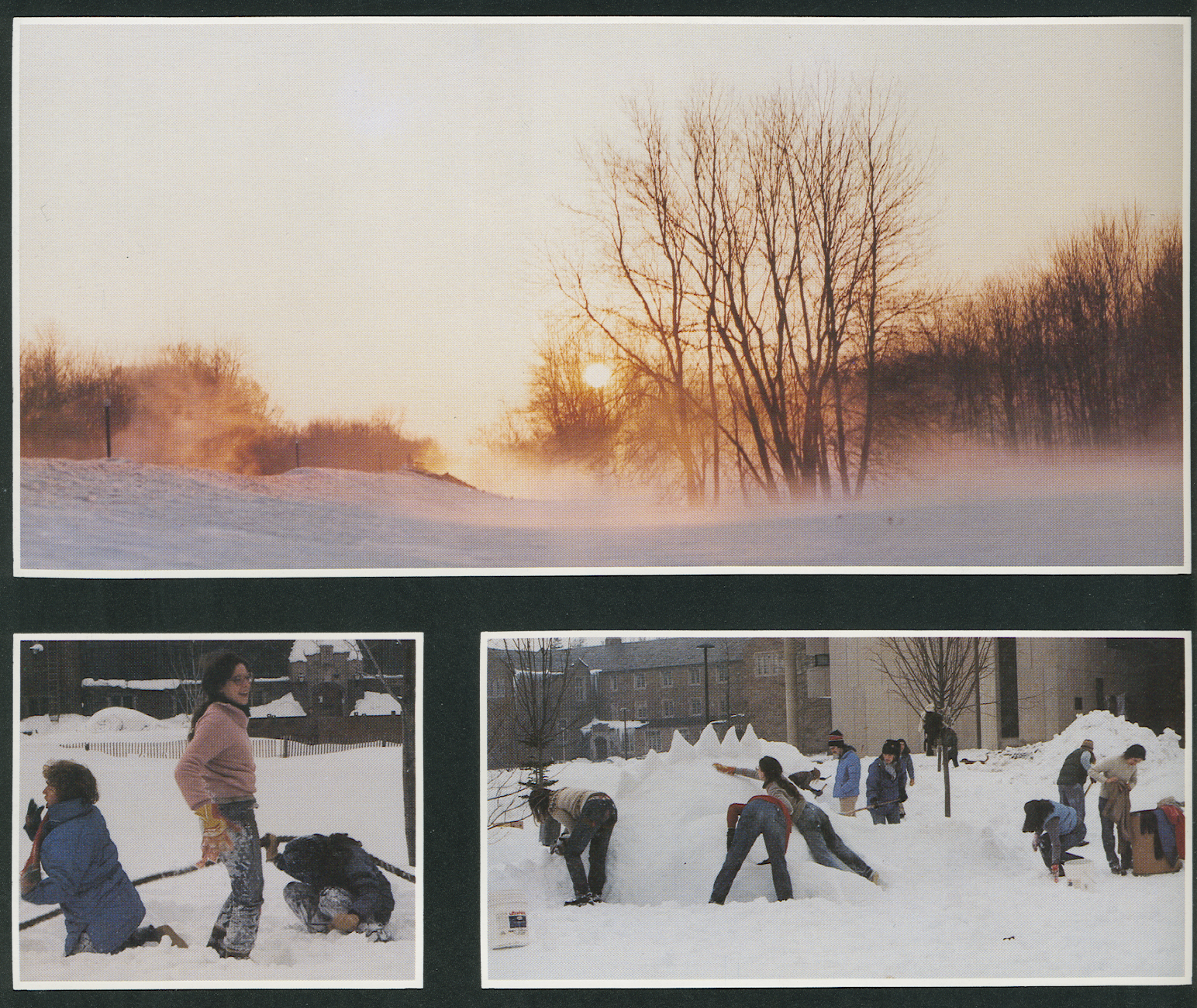
Winter in 1978
Winter in Clinton was both beautiful and beguiling. It also seemed to last forever. The long walk from the far dorms at Kirkland (Major, Minor) to the Hamilton Science Building stretched along footpaths edged by growing walls of snow that had yellow poles poking out, and the sheer height often seemed overwhelming. We joked that we lived in the great tundra and would be snowed in atop College Hill until May. It also meant we had excellent conditions for snowshoeing and cross-country skiing across the pristine expanse of the land behind Kirkland College.
Some of my other memories include checking out gear rom the Outing Club, madcap traying excursions down College Hill. playing platform tennis behind Milbank (and what is now Babbitt Dorm) on a sunny, but icy day, working on the potter’s wheel in List while it snowed all afternoon, hot chocolate at Stan’s Luncheonette in the village, sitting by the fireplace in McEwen warming our hands and gloves, having the ice rink almost completely to ourselves on Friday mornings, making toffee bars and Rice Krispy treats for the Coffee House, wearing layers and boots all the time, stir fry cooking on a hot plate in our dorm, the squishy sound of gators and boots on unplowed snow, the fiery red poinsettia bushes outside McEwen and the freedom of skiing through the silvery silence of Kirkland Glen.
Judy Silverstein Gray, K’78
I had cross country skied occasionally in Kirkland Glen during my first three years at Hamilton, but only in my senior year did I discover the magic of skiing Kirkland Glen at night in the snow. The wide flat trail allowed easy navigating by the light diffusing through the clouds, into the woods and onto the snow covered path. Having just read the Lord of the Rings trilogy (at the urging of my roommate, the late Richard Koelle (H’78) made the seeming magic more palpable. It was easy to image Gandalf or some elf hiding behind trees in the silent wood. The only sound, when I stopped, would be my breathing, and the occasional clump of snow falling from a branch.
Having gained confidence on cross country skis on the flat trail, and having some downhill skiing experience, I decided one day to try skiing Root Glen. Bad idea. Very narrow steep paths with hairpin turns. I quickly evolved an inelegant, but survivable, technique of grabbing a branch when I was going too fast, and allowing it to fling me face first into the snow bank. Wipe myself off, and try again. I do not remember how I got back up from the bottom of Root Glen, but the trip down is deeply planted in my memory.
Michael Margolin, H’78
I remember my first Winter Study at Kirkland, as being quite gray. Even the red, orange and yellow blinds could not warm the gray of the skies and the buildings. And it was always snowing. You stopped thinking to yourself, oh it’s snowing, because it was not ever not snowing. My parka had failed me, it was not nearly warm enough for the Clinton winters. Yet as I would walk home from a basketball game or the pub late at night, there was a strange serenity to the chill of the night and the sound of the squeaking crunch my boots would make on the snowy paths.
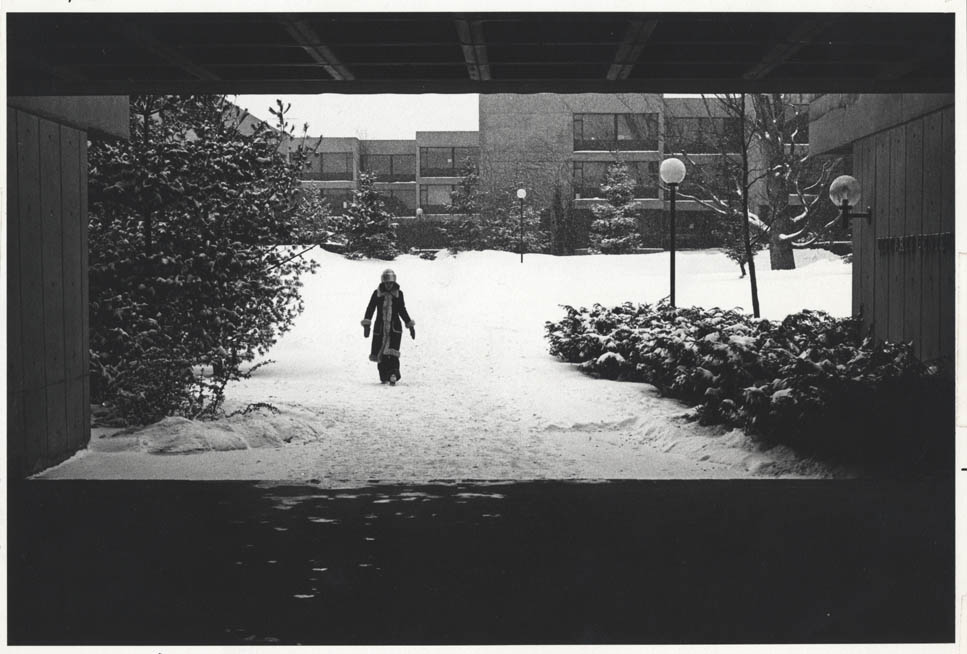
Campus in winter
I don’t remember what I studied that January, but I do remember that, despite the grayness, it was during Winter Study that I found my place at Kirkland. I was timid and nervous that first semester, and did not venture far from my room. But during Winter Study, I made friends and had adventures that made me sure I was where I should be. My fondness of those people and the memories of our escapades has not diminished. Kirkland was about growth, and that month I became a college student.
Margaret Babbitt, K’78
 Kirkland College