A Special “K” kind of thanks…
It has been an invigorating and fulfilling journey to launch this site, which brings back vivid memories and invites discussion on the education of women, particularly in a coordinate model. So to all the Kirkland folks, friends and family, faculty and administrators who took our calls without hesitation, offered ideas and cheered us on, we thank you.
Before any more time elapses, we send the most heartfelt thanks to Becky Pressman, K’78 who has provided key and substantive insight and guidance on copyright and legal issues. We’re most grateful she plans to continue in that advisory capacity. We already have a few more questions requiring your capable review.
Connie Halporn, another K’78-er, also deserves special mention for continued technical assistance and crucial tips for preserving and scanning imagery.
Kathy Collett, the Hamilton Archivist, has provided invaluable assistance, enthusiasm and belief in our work. The Alumni Office has also been instrumental and enthusiastic in helping us get the word out to all of you and in supporting our brainstorming sessions on and off the Hill.
It takes a dedicated team – and many who toil passionately behind the scenes, to create a large scale project. We’re humbled by the connection and commitment of so many.
Thank you!
Judy
The Womb Room
On the second floor of List Art Center, opposite the curved stairwell, there is a hidden gem of architectural history. It is seriously hidden, behind ominous coded keylocks. Access is restricted.
Behind those locks, I believe, lies an octagonal space originally designed to foster the emerging medium of “multi-media.” There were floor-to-ceiling projections screens on each of its eight walls. Near the ceiling opposite each screen was a projection window intended to accommodate slide or film projectors. Behind the windows were two tech booths wired to accommodate control equipment, including surround-sound (“quad” in the day).
The floor of this Room was carpeted in deep orange. No seating. Dim-able lighting. There was only one possible name for it but, unlike the Red Pit, it has not been enshrined by officialdom.
It’s most likely that this space was the brainchild of Ben Thompson, Kirkland’s architect. In Limited Engagement, Sam Babbitt describes a presentation prepared for the Trustees at a meeting at Ben Thompson Associates in Cambridge, MA, before Kirkland’s design had been approved:
… a large horizontal screen and three automated slide projectors, programmed to flash images in studiedly random order, now left, now right, now middle and every possible combination in between, and all of this was accompanied by a recording of some current ’60s music (the Beatles, Dylan, etc.) at the highest possible decibel setting. (p.91)
As Sam recalls, the Trustees were… nonplussed. Nonetheless,the Room came into being. To this writer’s knowledge, Jesse Zellner was the first to take advantage of the facility, when he presented a multi-image slide show of images captured in Washington D.C. at a major Vietnam War protest rally in the spring of 1970.
That show made a deep impression upon me. I spent the next year in D.C., working and studying at the Corcoran School of Art, and when I returned to Kirkland to complete my degree, I knew I needed to incorporate the Womb Room in my senior thesis exhibition.
These photos are the only record I have of the project (which included an audio track produced in the Electronic Music Studio, and film created in one of Nat Boxer’s classes). They don’t show much architectural detail, but do convey a little bit of the Room’s atmosphere.
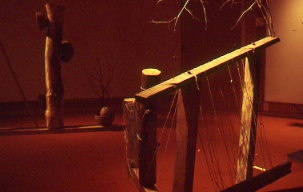
A '72 Senior Project exhibit
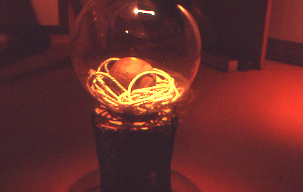
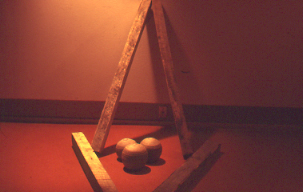 A year after graduation, I found myself in Cambridge, MA working for a firm that had emerged from an art collective specializing in new technologies. Within ten years, multi-screen slide shows had become a staple at corporate events, and supported an entire industry.
That industry was overtaken by digital media in the ’90s. But Hamilton College possesses a remarkable piece of its history.
Now, hidden behind digital locks.
Faculty Reflections
Rachel Dickinson, K’78 wrote the attached article about the legacy of Kirkland, for the Hamilton Alumni Review (vol. 67 (2002), no. 3, pp. 17-21). Doug Raybeck, Rick Werner, Peter and Nancy Rabinowitz, and Sue Ann Miller were interviewed for it. It’s a wonderful read, and our thanks to Katherine Collett, Hamilton Archivist, for scanning it: KirklandLegacy
Kirkland faculty were also interviewed shortly after the Hamilton/Kirkland merger, as part of a project initiated at Barnard College. We don’t have permission to reproduce that material, but transcripts can be read at the Burke Library. Here’s a listing of contents:
Kirkland College Oral History: Typewritten Transcripts (unbound), Audio Cassette Interviews, Video Cassette of 20th Reunion, Columbia University & Kirkland History Projects
1. Interview Transcripts/Memoirs
1.1 Eugene Putala
1.2 Carol Ann Bellini-Sharp
1.3 John Higby O’Neill
1.4 Hermione Williams
1.5 Jay Williams
1.6 Rick Werner
1.7 Nancy Rabinowitz
2. Interview Transcripts
2.1 Samuel Fisher Babbitt
2.2 Walter Beinecke
2.3 Richard Couper
2.4 David Ellis
2.5 Majorie McEwen
2.6 Millicent McIntosh
2.7 Debbie Moskowitz
2.8 Inez Nelbach
2.9 Ruth Rinard
2.10 Carl Schneider
2.11 Connie Stellas
3. Assorted interview transcripts and information about the project, including listing of interviews deposited in archives
4. Interview with Russell Blackwood (transcript)
5. Interviews with Millicent McIntosh, Bill Salizillo, Elizabeth and Dr. James Ring, Peter Rabinowitz (2), Richard Couper (transcripts)
6. Interview with George Bahlke (transcript and cassette)
7. Interview with David Ellis (transcript and a cassette)
8. Kirkland College Reunion June 6, 1992 (cassette and transcript)
9. Interviews and description of the project
10. Kirkland College 20th Reunion Dinner “Open Mike” in McEwen Dining Hall 6/6/92 [1 hr. 30 min. (2 copies)]
11. Kirkland College 20th Reunion at the Harding Farm 6/6/92 [2 hr. 40 min.]
12. Taped Interviews by Kristen Gavin Russell (1992) original, unedited cassettes
Then and Now: The Kirkland Generation
As an educational institution dedicated to innovation as well as excellence, Kirkland College was constantly questioning, examining, and redefining itself throughout its all too brief existence. In 1974, approximately halfway through its brief lifespan, the college’s Particulars catalog presented the results of two student surveys whose common theme was: “Where do we go from here?” The questions included:
- What were your main reasons for choosing Kirkland?
- What do you like about Kirkland now?
- What, if anything, would you change?
Former resident faculty member Carol Locke made the following comments about one of the surveys:
“A significant number of seniors felt that Kirkland, particularly its student body, is becoming too homogeneous. Allied with this was a real fear that both new students and faculty have lost the ‘pioneer spirit’ and are less willing than their predecessors to take risks and work hard to make Kirkland function as a truly innovative college. Both of these concerns were linked to an even more widely shared conviction that Kirkland is suffering, increasingly, from a ‘reality/rhetoric gap: that is, we claim to be something we are not, something which, perhaps, no college can be. By and large, the seniors retained a large reservoir of confidence that Kirkland can make good on its initial promises.”
Twenty five years later, the Kirkland Committee sent out a similar survey to three Kirkland and three Hamilton classes that graduated during the Kirkland era. The Committee, composed of about forty Kirkland alumnae, is dedicated to fostering the spirit and principles of Kirkland College on the Hill. The survey was designed to complement the Kirkland Generation panel discussion by providing a broader take on what Kirkland has meant to those who experienced it first hand.
Going over the responses, I was struck again and again by how much they have in common with the viewpoints expressed by Kirkland students in the 1974-75 issue of Particulars. The major difference: students back then were providing feedback which they hoped would help shape a living institution they assumed would last indefinitely. The 2009 survey tapped a deep vein of anger and bitterness because of what happened in 1978.
Still, the intensity of the feelings expressed (both negative and positive), the soul searching, and above all the earnest questioning of Kirkland’s purpose and ultimate value, remain the same. And for those of us who loved Kirkland, men and women alike, the memories are still vivid and alive, after all these years.
Read comments from 2009 survey
Elisabeth Horwitt K73
 Kirkland College