George W. Bahlke, 1934 – 2011
We learned the sad news that one of our beloved Kirkland professors passed away on February 1. As Sam Babbitt observed, “A fine man and a solid, first-rate member of Kirkland’s charter faculty.”
Many of us had the privilege of taking one of George’s literature classes. For me, it was the unforgettable Virginia Woolf Seminar in the spring semester—the last semester of Kirkland College—in 1978. I still have one of my papers, “The Marriage of Rainbow and Granite,” which was an analysis of Orlando. George’s gentle style, wry humor, and quiet enthusiasm made us all fall in love with Woolf’s work, a connection that stayed with me all these years.
I’m so very glad George was able to attend some of the 2007 All-Kirkland Reunion. I recall that he appeared at Natalie Babbitt’s talk in what was formerly the TV lounge of McEwen. We chatted briefly, and I remember thinking how dapper he looked in his ivory-colored jacket and fashionable hat. I appreciate all that he taught me, but I also feel grateful for our sporadic yet consistent communication over the years.
We hope you will share your recollections with us—and join us in extending our condolences to George’s family and friends.
Jo Pitkin, ’78
Winter Study
It’s January in New England. Outside my window is a pile of shoveled snow higher than my head. Another storm is expected Wednesday. I spend my days alternating between bursts of physical activity (walking the dog, shoveling), writing, and spacing out. A good time to reminisce about Winter Study on the Hill.
Section title from Particulars '74-'75
The ’75-76 Particulars described Winter Study this way: “Kirkland’s 4-1-4 calendar allots the month of January to the intensive study of a single subject. During this time, you devote all your efforts to one area which especially interests you, either by developing and executing a specific independent project or by taking a course at Kirkland, Hamilton, or another institution. For many students, Winter Study is a time to experiment, to try something new or unusual, or to explore an interest they would not be able to pursue during the regular school year.”
Winter Study wasn’t unique to Kirkland: other non-traditional colleges, such as Antioch, had similar programs. Still, it was uniquely Kirkland, designed to be an adventure, an experiment, a chance for students to create their own academic experience. Giving young people that much autonomy involves risk as well as opportunity, however. Doug Raybeck experienced both the up and down side, during his decades-long tenure as Professor of Anthropology on the Hill:
Whereas at most schools, the majority of students fell somewhere in the middle of the performance curve, Kirkland students tended to be either “marvelous self-starters who challenged you,” or academic misfits who goofed off, or else were “flying off the floor and sticking the walls,” Doug recalls. Winter Study brought out similar extremes: “While many students worked hard and quite creatively, others, particularly those who pursued Winter Study opportunities far to the south of Clinton, used it as a bit of a holiday.”
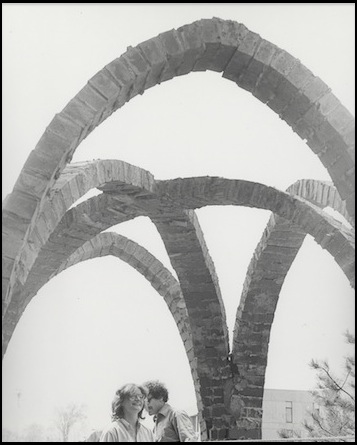
photo by Bob Zeigler
Sam Babbitt agrees. “Sometimes Winter Study worked very well, and sometimes did not, depending on how seriously it was taken by both faculty and students.”
Sam vividly recalls professor Ralph Leiberman and his students building a series of Gothic stone arches that originated from four stone posts and met in the middle. “It was wonderful, part engineering, part artistry, part oh my god will this work? Which it did. The moment when they put in the capstone was very dramatic.”
The initial impetus for Winter Study “was wanting, early on, to do as many independent projects as we could, and really wanted to get them into curriculum,” Sam says. There were a few issues to sort out, like how to coordinate with Hamilton’s academic schedule, and lightening the regular semester workloads of faculty who taught full winter study courses. Some structure was also needed: the Winter Study Committee oversaw and administered the program, and provided a theme – optional, of course – for professors and students to focus on. In 1975, the theme was Corruption: perhaps inevitably, given that this was right after Watergate.
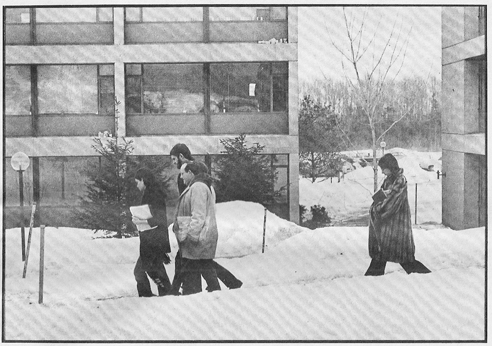
Photo in '74-'75 Particulars
Students could also choose to opt out of Winter Study altogether, and many did, at least for one year. But students who took the opportunity seriously did amazing things. In 1975, for example, Meredith Melvin (’77) did environmental research in the Teton Range; Ann Fiester (’79) did backstrap weaving in Guatemala and Eva Heisler (’77) did an independent study of Anne Sexton’s poetry.
Here are some other notable winter study projects and experiences, told in Kirkland women’s own words:
Adriana Bate, ’73: “I set about attempting to translate one of Gustavo Adolfo Bécquer’s “Leyendas”, a series of sometimes-fantastical short stories – from Spanish into English. What I remember, besides the spell of being on campus when so many others had left, was that I felt as though I’d bitten off more than I could chew. I had believed that the process of translating would be fairly simple: that all I had to do was take the words that Bécquer had written and just turn them into English. It seemed like a straightforward exercise.
These stories often incorporate spiritual and even magical elements, and the language is highly poetical. I was in the library for days, reading and rereading the story, with a couple of Spanish-English dictionaries next to me. I felt like I was wading through romantic language piled up to my chest. It wasn’t so much that I didn’t understand what the poet was saying in Spanish, but that I lacked the skills in my own language to express it without sounding, well, idiotic.
While the project itself ultimately was not successful – I didn’t manage the translation – I still felt as though I had achieved an inside appreciation of the translator’s art. Unfortunately, the experience also left me with a lingering sense of dissatisfaction with most translated literature. Still, when I read one of Richard Wilbur’s verse translations of Moliere, I can get a little emotional.”
Julie Weinstein, ’74: Winter Study 1973, my junior year. My project was to translate “New Poems” by Pablo Neruda because I hated the published translation. Sat in my room all day translating and listening to Bach’s Brandenburg Concertos. Spent the evenings enhancing a new friendship through long chats, on-campus movies, sitting around the coffee house. A truly magical and timeless moment.
Judy Silverstein, ’78: I did two Winter Terms on Capitol Hill- writing about nitrosamines and their deleterious effects on public health, on national park legislation to create Sleeping Bear Dunes and Isle Royale in Michigan, and one year with the National Trust for Historic Preservation capturing oral history from Mrs. Leighey (who lived in F.L.Wright’s Pope-Leighey House — learning about the man himself). I keyed and cataloged flora and fauna, since the house had been moved from its original location to an entirely different landscape, and documented architectural anomalies. I learned everything I could about F.Lloyd Wright, his designs and their connection to the land. I also studied Mozart’s Opera on the Hill one lovely and snowy year. It was something I intended to suffer through, and ended up loving the music and the pageantry. To this day, I can still hear individual instruments at performances because we were taught to develop an ability to listen. All three Winter Study programs were especially intense, but they taught me to delve deeply into subjects and pursue them with a singular joy.
Joanne Papanek (Orlando), ’74: “My weirdest Winter Study was studying Indonesian. My parents lived in Jakarta, Indonesia when I was at Kirkland, and I wanted to know the language. Cornell had recently published a two-volume text,. Much to my surprise (and very good luck) Doug Raybeck, had done his doctoral work in Malaysia. Malay and Indonesian are quite similar. We worked with the Cornell material and talked (as best I could) in Indonesian. One day when we were having an Indonesian “conversation” he began to speak quickly, in a guttural tone with strange, unintelligible words. He kept on talking until he saw my stunned look, and realized he had been using the dialect from the area where he had done his field work.”
Penny Watras (Dana), ’78: “Freshman year, I did a paper on Thomas Hardy, under Nancy Rabinowitz, and sophomore year I did the London Theater program with (Hamilton professors) Ed Barrett and Fred Wagner. Some of the plays we saw included The Rocky Horror Picture Show; Phaedra Brittanica starring Diana Rigg; and All Walks of Leg, which was written by John Lennon.”
Diane Pies (Toby), ’78, who was Penny’s roommate during the London Theater program: “The trip still means so much to me, that I get kind of choked up writing about it. An exquisite menu of theatrical performances. We had the almost impossibly rare opportunity to see Sir Ralph Richardson and Sir John Geilgud perform together, in No Man’s Land. I never had an experience like that, ever again. We were too young to appreciate it, I think! I remember Penny and me going to pubs and discussing the plays right afterwards, and the papers we wrote on each play. The professors wrote amusing, enthusiastic comments and I kept them because they still make me laugh.”
Zan Tewksbury, ‘80: “The first year, I was cast to be in a film to be made by Harry Kondoleon for his Senior Project, which could not be made at the last minute because Nat Boxer was supposed to supervise the project and he was “detained indefinitely” in the Philippines doing sound for Apocalypse Now. So I talked my way into an upper level English class at Hamilton on Joyce’s Finnegans Wake. I did so by convincing the professor, John Gordon that, like himself, I loved James Joyce more than life itself (which was just about true). Thank Goddess for that. It was in that class that I met and befriended my lifelong compadre, Jo Pitkin. No greater friendship was ever forged out of such a heady work of literature. Oh, and I aced my final paper, which was entitled “Paradox Lust.” Got to love that Ham/Kirk juxaposition…!”
Nancy Aaron, ‘78: “A bunch of us signed up for a “Crime and Punishment” class with a Hamilton faculty member. On the first day, he informed us that this was no “gut” class, and there would be no “fun” crime stories. This would be a complete full semester philosophy course, taught in 3 weeks, with mid-terms, finals, papers, etc. He expected us to spend 5-6 hours a day outside of class on the homework. Needless to say, I (and 90% of the class) dropped it on the first day. Not quite what we expected. Instead, I borrowed a roommate’s clarinet, found a music teacher on campus and spent a hour a day learning how to play, with a paper on “Emboucher” delivered at the end of the month. Unfortunately, I had to return the clarinet at the end of the semester, and I’ve never played it since. I’ve always regretted not taking that first teacher’s challenge and really delving into a subject matter intensely for 3 weeks.”
Robert Kaplan, ’76, provides a Hamilton perspective: “I remember taking a failed philosophy class at Hamilton my first year and a splendid non-course, ‘How to succeed while living the good life of the artist,’ which was total BS. And snow. Lots of snow. I remember my senior year I didn’t have to do a winter study so I played in the snow.”
As for me, Elisabeth Horwitt, ’73: My freshman year, I played Olga in an on-campus production of Chekhov’s Three Sisters, which was both fun and educational. Sophomore year, when an arctic blast broke my glasses, I took that as a sign that I should spend the rest of the month at home. My third year, I participated in a choreography class with Rhett Dennis and wound up wowing the audience with a sultry jazz routine performed to Laia Ladaia by Sergio Mendez and Brasil ’66.
I also remember playing in the snow and watching the campus dogs play in the snow, traying down the hill behind Bristol Campus Center, and my glasses fogging up as I entered the Pub. Winter Study on campus was peaceful, yet intense. Many, if not most of us, had time to relax. Skiing, drinking (and toking), Hearts games and bed hopping were popular activities. But we also took advantage of the time to create and experience something new and exciting: a gothic arch, a performance, a useful item for one’s resume, a philosophy paper – as well as closer bonds with teachers and fellow students.
It was a good time.
By Elisabeth Horwitt ’73
Red Weather Redux
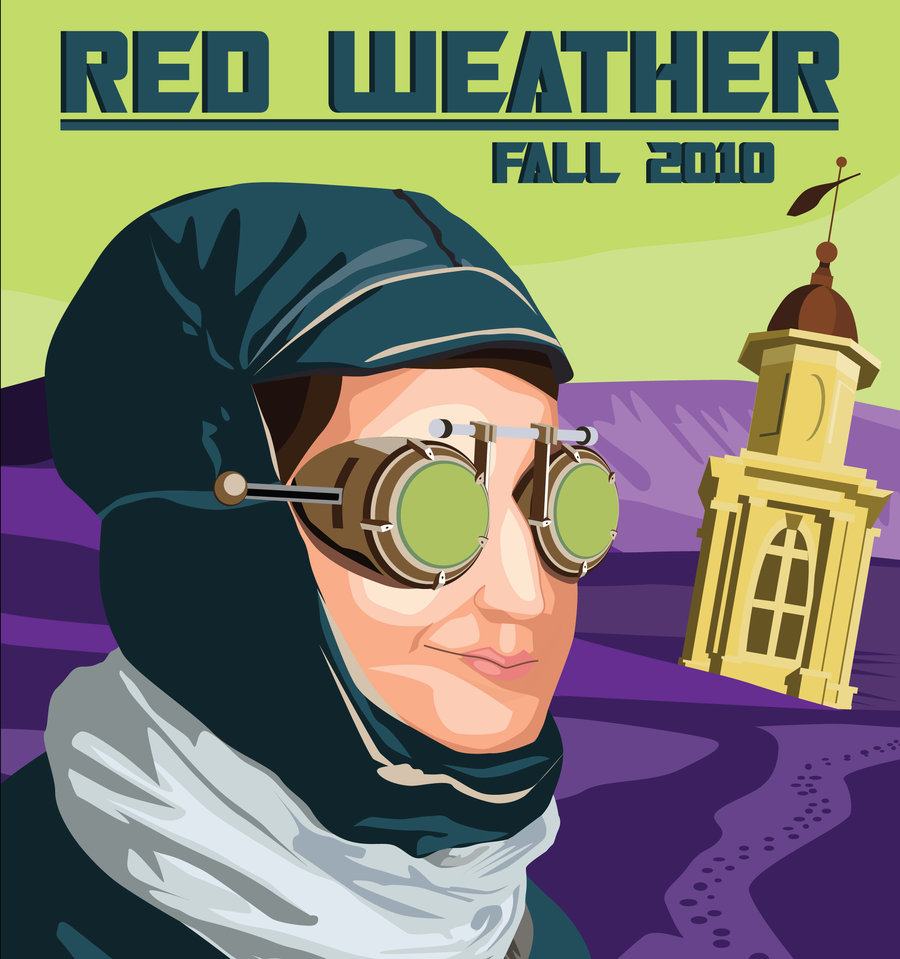
Cover art by Colin Wheeler '11
In October 2010, Nin Andrews (H’80) and I gave a poetry reading in the Wellin Atrium of the Science Center at Hamilton College. During our visit, Nin and I also met with students in Jane Springer’s Advanced Poetry Workshop and some members of the current Red Weather staff. (One staff member said happily, “I’ve never met real Kirkland women before!”) What struck me most was that today’s staff faces the very same issues with Red Weather that I did: apathy, budget constraints, worries about layout and typos.
Afterwards, Hamilton senior Olivia Wolfgang-Smith wrote:
As the current Editor-in-Chief of Red Weather, Hamilton’s literary magazine, I was lucky enough to interview the magazine’s founder, Jo Pitkin K’78, earlier this year. Pitkin met me and other current RW staff members with folders full of artifacts and memorabilia from the magazine’s history, from copies of the first issues to caustic early reviews clipped from The Spectator. Hearing about Red Weather’s early life and production, and Kirkland’s vibrant literary community in general, inspired us as we worked on the fall issue. It was wonderful for our generation of students to connect with our shared history, and we hope to continue to produce a publication that honors its enthusiastic and innovative roots.
And here is the full text of the interview that appeared in the Fall 2010 issue of Red Weather.
What prompted you to found Red Weather? Why did you choose the Stevens line for the title?
Hamilton has had a number of college-funded literary magazines. I recall both Wintersetl and Watermark, for example. In my freshman or sophomore year at Kirkland, I joined the staff of Dessert at the Plaza, the literary magazine at Kirkland and Hamilton at the time. In the spring of 1976, the outgoing editor persuaded me to run for his position. After I was elected, I decided the magazine needed both a new name and a new look.
To me, Dessert at the Plaza had a connotation of urban life: breakfast at Tiffany’s, rush hour, taxis. I wanted something more relevant to Clinton and the Mohawk Valley. I talked about the search for a name replacement with my writing professors. At the time, Michael Burkard was reading Wallace Stevens and suggested “red weather” from the final line of “Disillusionment of Ten O’Clock” , as a possible title. My staff deliberated on a short list of favorites and voted on Michael’s suggestion.
To us, this title seemed to better reflect life on the Hill. Our instincts must have been on target; Red Weather has lasted nearly continuously for the past thirty years!
What was the magazine like in its early days?
I edited six issues of Red Weather from fall 1976 to spring 1978. We produced three issues a year. Not only did I change the magazine’s title, but I also reduced its trim size from 8½ x 11; created separate editorial, production, and art staffs; contracted with a different area printing company; and introduced the use of blind submissions. All these changes were designed to make the process more democratic and efficient and to create a more aesthetically pleasing magazine.
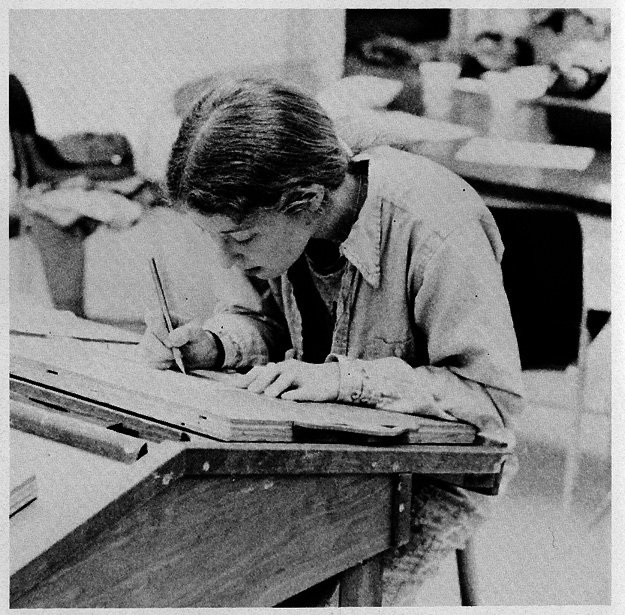
Jo Pitkin working on publication layout (from Roots in the Glen yearbook, 1977)
Our early issues were rough but gradually improved as we got comfortable using The Spectator’s photocomposition equipment and doing page layout with pica rulers and X-acto knives. Remember, this was before computers! The layout was done by hand. We typeset the magazine from manuscript in room that smelled like vinegar from the fumes of film developer.
Despite an obvious shift in technology, RW then and now are pretty much the same. My issues included student art, photography, poems, and fiction, just as RW does today. Much of the work was created on campus as a result of workshops and studio art classes; some of it was created independently outside of the classroom.
Like you, I tried to get a diverse sampling of submissions. I advertised with posters and ads in The Spectactor. I tapped whatever sources I could. But I never thought of holding a launch party to celebrate the arrival of an issue. All I remember is waiting for the printer to arrive with boxes of freshly minted copies of the magazine. Then I ran around campus with some of my staff to distribute it in obvious places: the libraries at Kirkland and Hamilton, Bristol Campus Center (which at the time was a central gathering spot), and so on.
Once I started writing articles for Kirkland’s new interactive archive (www.kirklandalums.org), I delved into some of the history of RW. After all these years, I suddenly realized that I had most likely been the first woman on the Hill to edit the student literary magazine. At that time, it was unusual for female students to head campus organizations at Hamilton. It was so unusual, in fact, that several of us were interviewed about the experience for an article entitled “Women in Charge.” After I graduated from Kirkland, a number of Kirkland women succeeded me, including Barbara Berson, Vicki Kohn, and Francesca Richardson.
Could you describe Kirkland’s creative writing program?
Kirkland had one of the earliest undergraduate programs in creative writing in the nation. It was housed within the Arts Division (rather than in the English Department where it is at most other colleges). When I was a student, there were only two dozen colleges in the United States that offered a B.A. in creative writing, so it was fairly distinct.
I took the Intro to Creative Writing class with Bill Rosenfeld, and later studied poetry with Michael Burkard and Tess Gallagher. I also took an Advanced Fiction workshop with Bill. There were other writers who taught creative writing at Kirkland prior to my arrival, including the poets Naomi Lazard and Denise Levertov.
Many of us went on to earn MFAs. A few years after Kirkland, I attended the Writers’ Workshop at the University of Iowa, where I studied with Larry Levis, Donald Justice, Jane Cooper, and Sandra McPherson. I had to write a book-length poetry manuscript for my MFA thesis. Believe me, this was easy compared to doing my Senior Project in creative writing at Kirkland. I felt so well prepared for graduate school as a result of my Kirkland training. Our Senior Project was an independent, self-designed project that was intended to reflect the culmination of our studies. The skills I learned from my Senior Project (which primarily focused on the writing of a sequence of poems based on Russian literature and the producing of a broadside) have been invaluable, especially in the work world.
One thing that has stayed me all these years is the wonderful sense of community that developed among the writers at Kirkland. We supported one another, celebrated one another’s accomplishments. We still do. I regularly look for and read work by my Kirkland classmates. I just did a reading on the Hill with Nin Andrews, who arrived at Kirkland in 1977, and I’m editing an anthology, Lost Orchard: Prose and Poetry from the Kirkland College Community. To date, I have approximately fifty submissions from Kirkland alumnae as well as from former faculty and members of the administration.
You have worked extensively in educational writing and editing in addition to writing poetry. What are the challenges and rewards of working with both technical and literary writing at the same time? Do you have a favorite form or genre?
I credit my work on Red Weather with my interest in the field of book publishing. I enjoyed the feeling of producing something and working collaboratively. Six months after I graduated from Kirkland, I was working at Houghton Mifflin in Boston. I eventually became an editor there.
Now I earn a living as a writer. That’s a huge reward—and a relief, too. I can use what I’ve studied and worked hard at in a most practical way. I primarily write educational materials for K – 12 students, so I apply what I’ve studied to writing grammar and composition, literature, and reading textbooks.
I find that the discipline of writing every day under a deadline helps me be more disciplined about my poetry. On the other hand, I have less time than I would like to devote to my creative work. This is a challenge, though, that I would face if I worked as a professor, a plumber, or a psychotherapist. It doesn’t bother me that I juggle two distinct forms of writing at a time. I just wish I didn’t have to work so much to earn a living!
In recent years, I’ve had the experience of writing something for a textbook that stuck in my mind. In particular, I wrote a short story about luna moths. I later turned some of the imagery from this reading passage for kids into a poem, which will be published next year in a terrific magazine, Little Star.
Who are some of your favorite authors?
There are many! Favorite poets include William Carlos Williams, Robert Frost, H.D., Louise Bogan, Elizabeth Bishop, Francis Ponge, Tomas Tranströmer, Emily Dickinson, Walt Whitman, Sylvia Plath, Louise Glück, Gillian Allnutt, Ahkmatova, Tsvetayeva. Of course, I read the work of my many Kirkland and Iowa classmates and teachers.
My short list of favorite fiction writers includes Stephen Crane, John Banville, Willa Cather, Bruno Schulz, Edith Wharton.
What projects are you working on now?
Projects I’m doing for money: I’m currently writing a children’s trade book for a new history series called Once in America, and I’m writing online instructional materials to give students extra help with state-based reading tests. In 2011, I’ll be writing several biographical sketches for a trade series called Notable American Women.
Projects I’m doing for love: Besides the Kirkland anthology, I’m also working on two chapbook-sized series of poems. I have a new full-length manuscript of poems in the works, too.
by Jo Pitkin K’78 and Olivia Wolfgang-Smith ’11
 Kirkland College
Happy One-Year Anniversary!
Virtual celebration with online Kirkland College community
During the summer of 2009, we three sat around a dining room table in Arlington, Va. surrounded by plates of delicious fruit and cheese. We brainstormed our way through projects that the Kirkland College Archives, Media and Publications Committee might tackle to encourage storytelling, preserve artifacts, and capture memories. After much spirited discussion, we decided to create an interactive web site where alumnae and friends could post their thoughts and memories, reconnect, and document aspects of the Kirkland experience for future generations.
We’ve put in countless hours developing, researching, and writing articles; learning how to navigate WordPress; and personally connecting with former teachers, staff and friends—and even other Kirkland women we might not otherwise have met. The bonds we formed reach across this country and across an ocean.
As we toast you—the women, faculty, parents, staff, and friends of Kirkland College—we also wish to thank the following for their contributions and support: Hamilton Archivist Katherine Collett, Sharon Rippey and Pauline Caputi at Hamilton College’s Alumni Office, Connie Halporn, Rebecca Pressman, Penny Watras Dana, Jan Sidebotham, and Elisabeth Horwitt Putnam.
And we’d like to share a few notable milestones:
We also have two announcements to make:
We are now linked to Jean McGavin’s (K’76) storytelling site, StoryChip, where you can submit longer, more personal narratives.
Connie Halporn K’78 is coordinating Particulars, a new “mystery photograph” feature for our site that will focus on images from the archives at Burke Library.
We do this work on a volunteer basis in between jobs, family, and community involvement—without any financial assistance or remuneration. The impetus comes from remarks in the foreward of Samuel F. Babbitt’s Limited Engagement:
“What is missing, unfortunately, is the texture of the place as seen and felt by students and faculty in and out of the classrooms and residence halls and offices. I wish it were possible here to show those aspects, since that was what Kirkland was about. But those memories and experiences are for others to write about in their turn.”
Writing about our unique history and traditions will not only preserve our legacy, but will also help current students and faculty learn about what Kirkland was and how Hamilton has evolved. That’s why we encourage you to log on, share a thought or an image, and encourage those who shared the experience to do the same. Professor George Bahlke’s death on Feb. 1, 2011 underscores the urgency of capturing our Kirkland impressions.
Here’s to another productive year filled with more of your recollections and personal narratives!
Cheers!
Jo Pitkin K’78, Jennie Morris K’72, Judy Silverstein Gray K’78
Share this: