American Studies Meets the Press
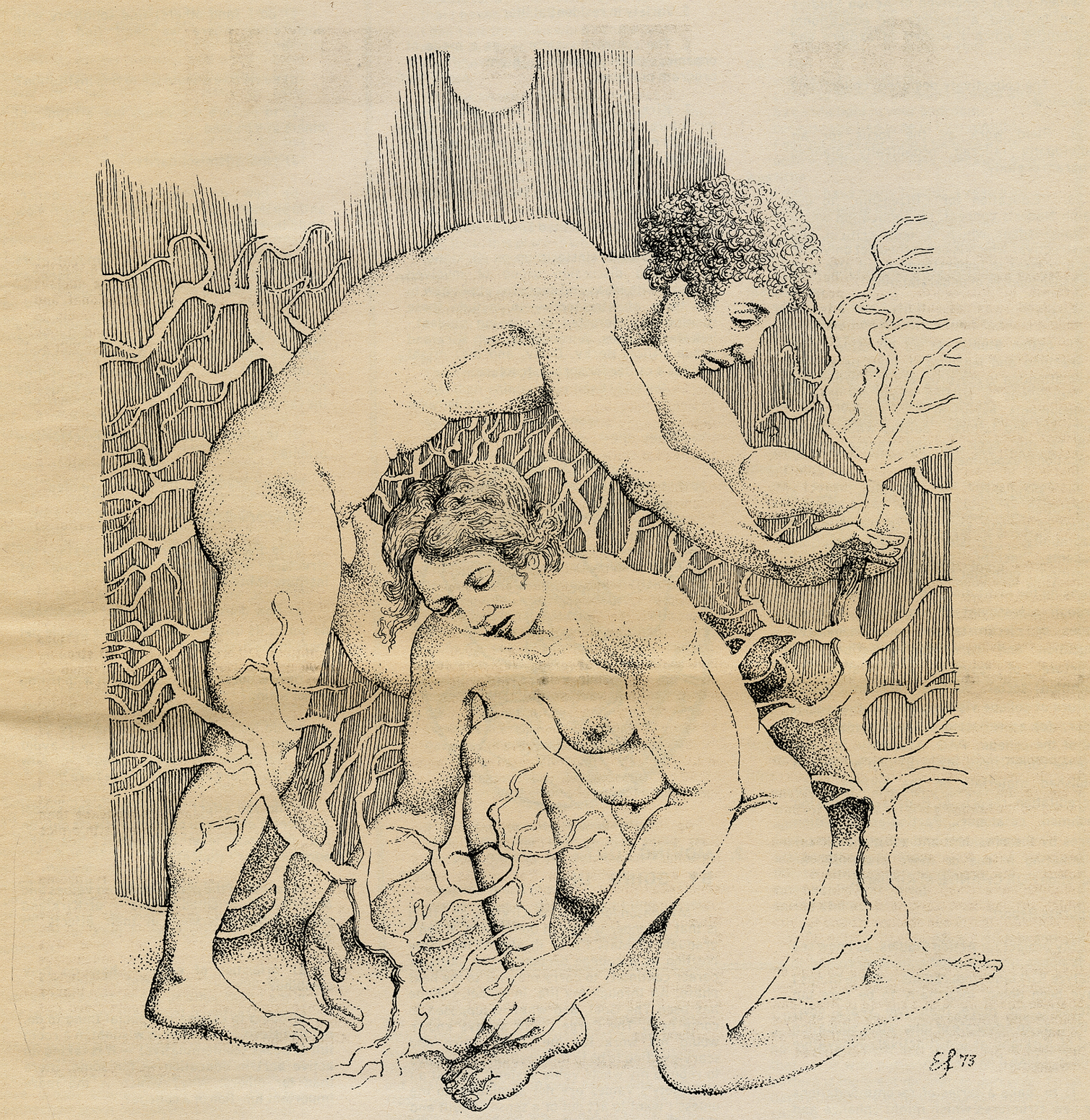
drawing by Eli Friedensohn, in Action Studies
At the 1989 meeting of the American Studies Association, Allen F. Davis of Temple University gave the Presidential Address, entitled “The Politics of American Studies.” In it he noted that,
….the forum for a dialogue between those who called themselves radicals and those more traditional … helped revitalize American Studies in the early 1970s and prevented the divisions and despair that infested many other academic groups during these years. Perhaps the most important place where such dialogue took place was the Kirkland College conference of August 1972. ( full text of the address can be read at this link.)
Davis credits Doris Friedensohn, Kirkland Dean of Students and Associate Professor of American Studies, for hosting what became known as the “Kirkland Institute.” Friedensohn joined the administration in 1970, after her predecessor, Inez Nelbach, retired. Recently, Doris shared some thoughts and recollections with us:
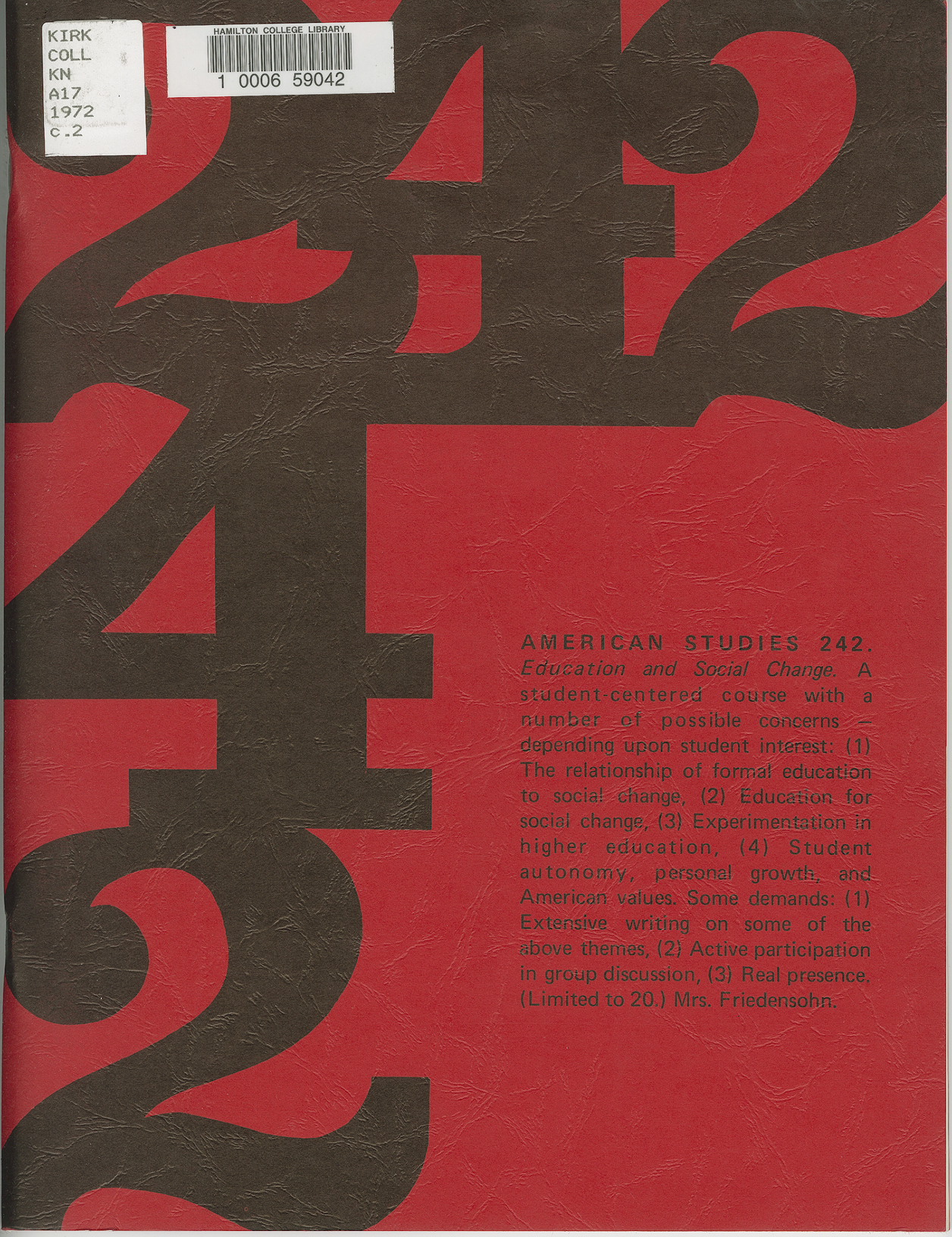 In the course of writing acknowledgments for [her latest] book, Cooking for Change: Tales from a Food Service Training Academy (Full Court Press, Englewood Cliffs, NJ, July 15, 2011), I couldn’t help remembering and acknowledging one of my favorite Kirkland projects. I’m referring to a small book, published by the College, 242: Education and Social Change, written with Daphne Petri (’72) and with illustrations by Elias Friedensohn. This little volume spoke to what I took to be the heart of the Kirkland experience. It asked, “How does education shape us and change us and how can we use this Kirkland education to make further changes in ourselves and our thinking?”
Of course, it was a mark of the ’70’s to speak about “social change” and to connect it idealistically with the democratizing of higher education — and with empowering students. At Kirkland, the focus was on empowering women students — to have the highest expectations for themselves and to demand support for those expectations from the institutions educating them. The time was right. And ripe. Feminism gave us good rhetoric, some organizational tools, and plenty of company. Students in my course, American Studies 242, “Education and Social Change,” wanted their lives to matter and believed that Kirkland existed to enable them to imagine what might matter and how they might move forward.
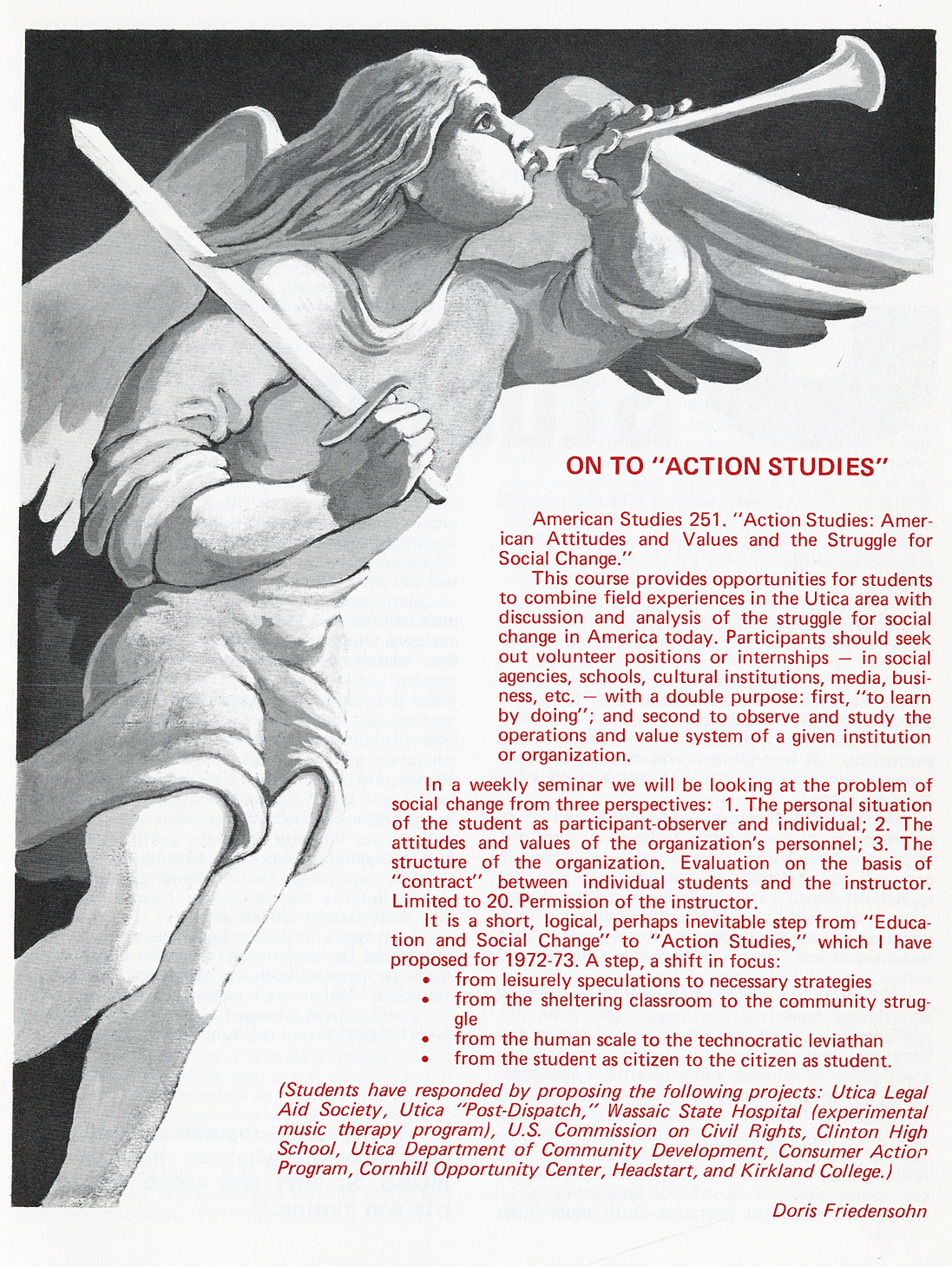
As a young faculty member and dean, I shared those good hopes, some of which were, of course, wishful thinking. Still, I valued that energized and positive way of thinking just as I valued Kirkland’s willingness to publish 242 in 1972 and a year later to publish another collaborative effort, Action Studies: American Attitudes and Values and the Struggle for Social Change, with Gwynne O’Gara (’73) and with illustrations once again by my husband Eli. This book revolved around students’ internships, which were a class requirement. The publication is a kind of conversation between the students and me on what it takes to make small changes in the world beyond ourselves.
 The Kirkland work proved to be a forerunner and model for 25 years of collaborative feminist pedagogy at the former Jersey City State College, now New Jersey City University. Learning from Kirkland, I persuaded JCSC to publish a faculty/student collaboration, Generations of Women: A Search for Female Forebears, written with my colleague Barbara Rubin (1984). While Kirkland students asked themselves, what are we learning from looking critically at our college and ourselves, students at JCSC focused on lessons taught by women in their families – as they understood struggle and challenge, inequities and unexpected opportunities.
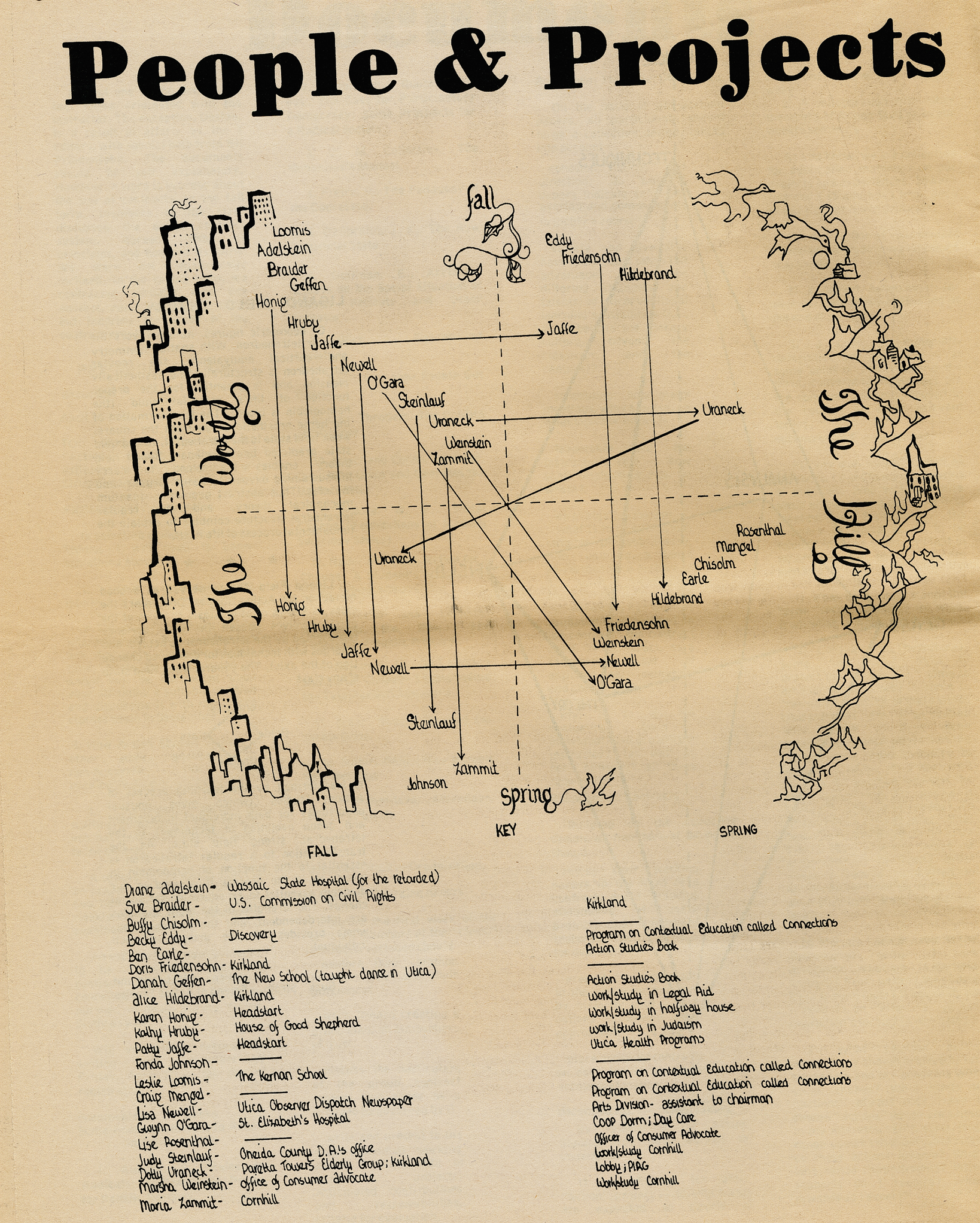
Diagram from Action Studies publication
This brings me to my current project — about very poor people, mostly minorities, and many who are ex-convicts or recovering addicts. The institutional setting is a job training program for food service workers located in New Jersey’s largest food bank, right on the border of Newark. These students, ages 19-70, have “learned” to expect very little from a harsh and deeply unfair world. Their challenge is how much to expect from themselves – – how much to dare to hope for, given their previous histories, family troubles, lousy educational training, dangerous neighborhoods, and minimal resources. Some hours of the week, I am hopeful for them; on those occasions I want them to prove to themselves (and to me) that “opportunity” isn’t dead in America and that getting (semi) skilled work, even at poverty wages, can be a source of pride and a proverbial turning point. What I’m saying, very carefully, is that while I no longer have large hopes for institutions or for “social change.” I still think individuals can be helped to put their lives to good purposes, and, if they are lucky, can become the change agents of their own experience. This sounds suspiciously like Kirkland rhetoric — and that’s what I wanted to acknowledge here.
Watching President Obama’s struggles with a recalcitrant Congress and nervous country and thinking back to 1970, I appreciate how easy it is to talk about change and how difficult to make the talk meaningful. Back then, we couldn’t begin to imagine the power of banks, insurance companies, lobbyists of every stripe, the media and the net, organized religion and all those fringe lunatics who refuse to stay on the fringe.
Perhaps your didn’t bargain for that rant — but it comes from remembering the idealism and innocence of those Kirkland years. That Kirkland died, as Sam’s book Limited Engagement suggests, was partly a function of innocence in relation to Hamilton. And partly a consequence, as we all know, of its ideas going mainstream.
[Ed. Note: A gallery of images and illustrations from 242: Education and Social Change and Action Studies: American Attitudes and Values and the Struggle for Social Change can be seen at this link. A contemporary video of Prof. Friedenshohn discussing her husband’s work and legacy can be viewed on YouTube.]
Are You Ready?
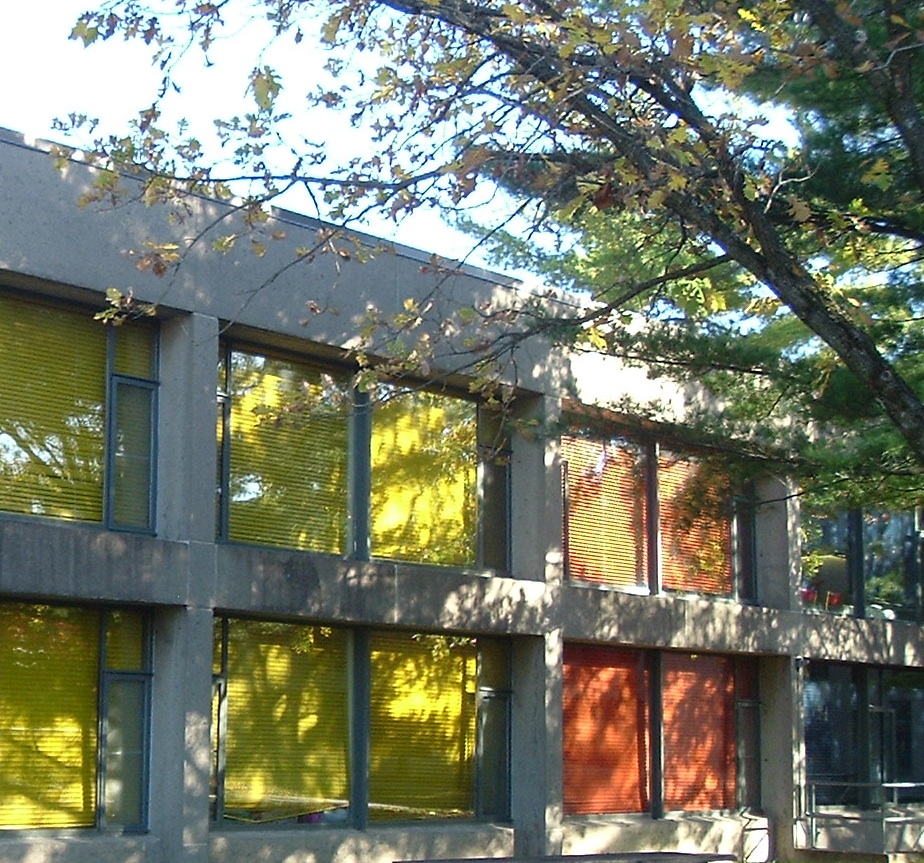
Do you remember shopping for orange, red, and yellow sheets?
Packing your stereo, typewriter, hot plate?
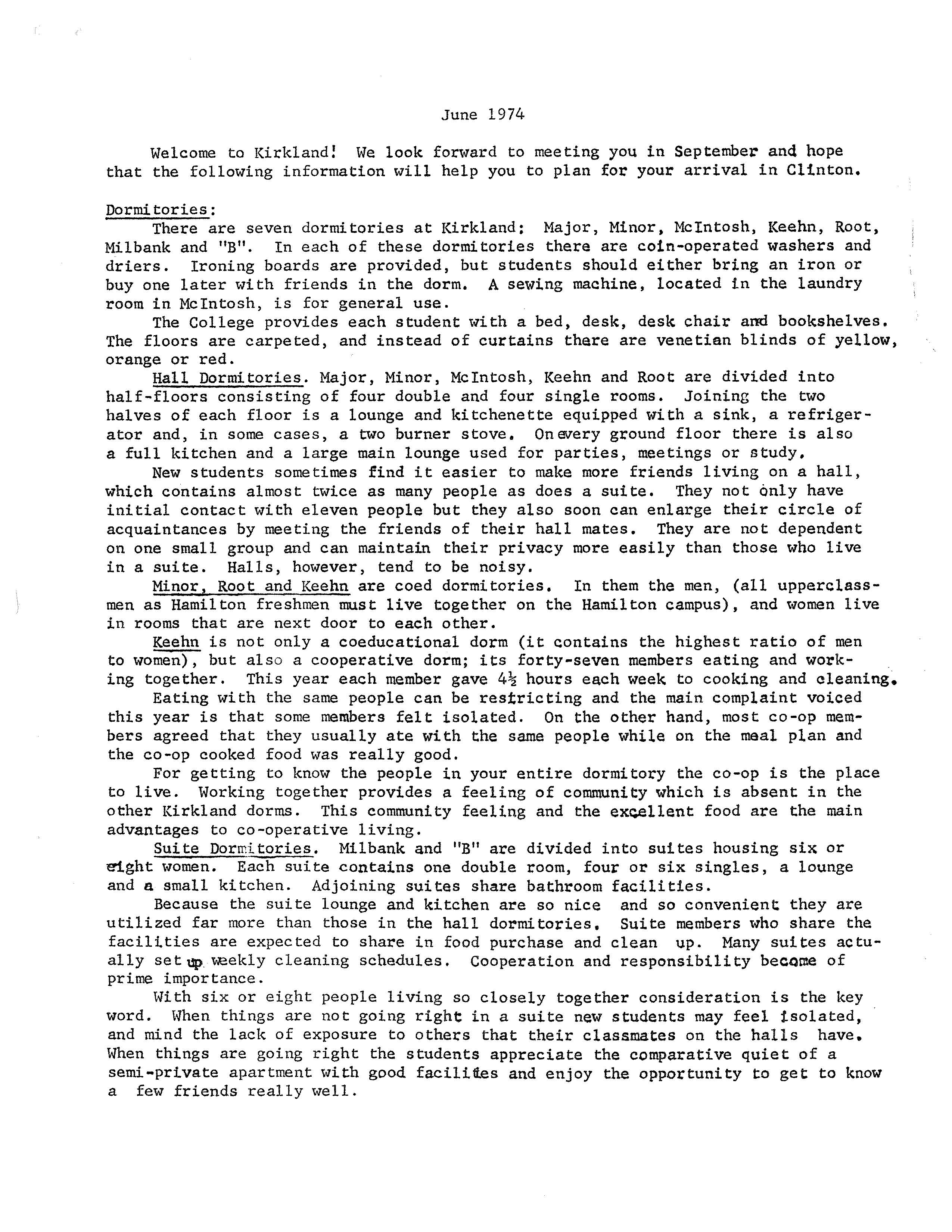
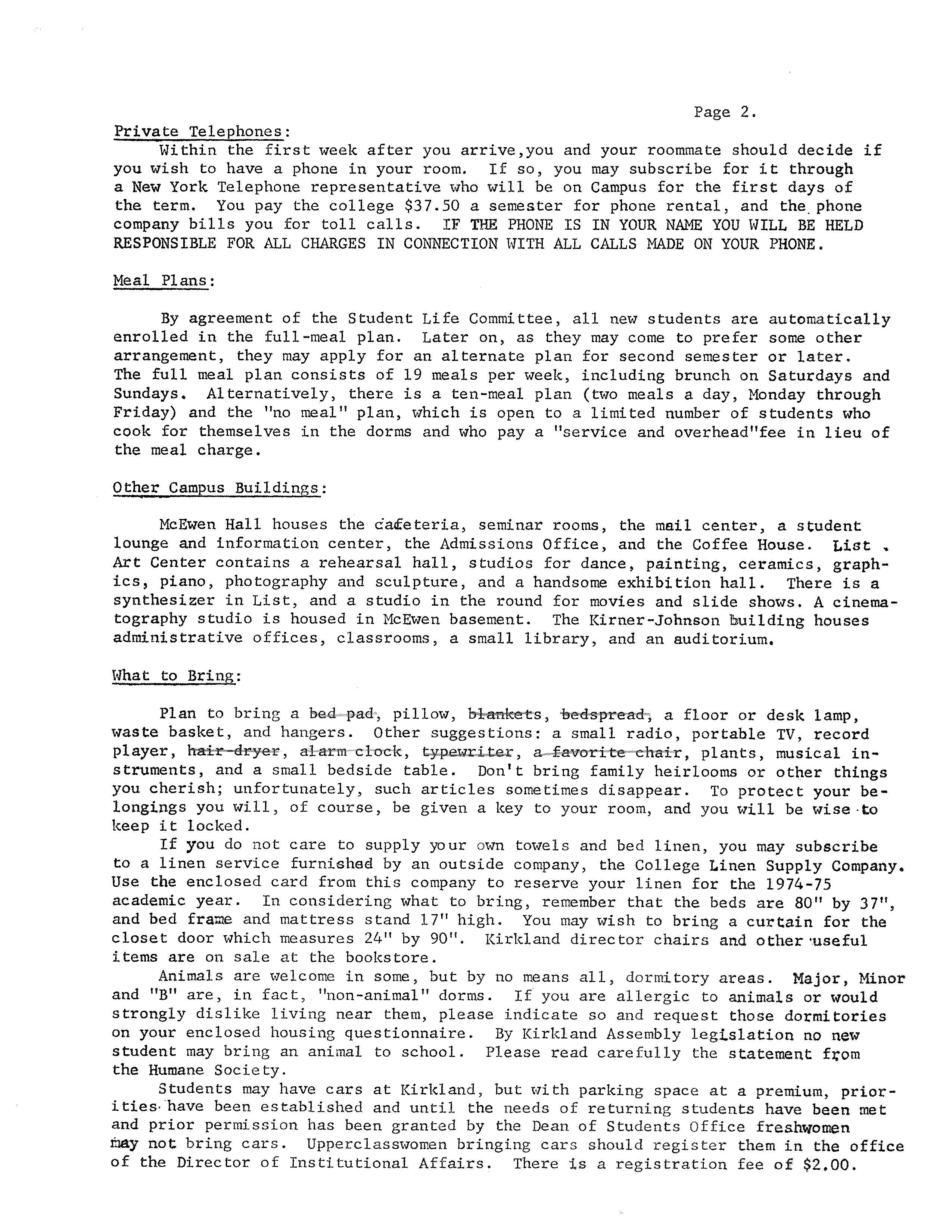
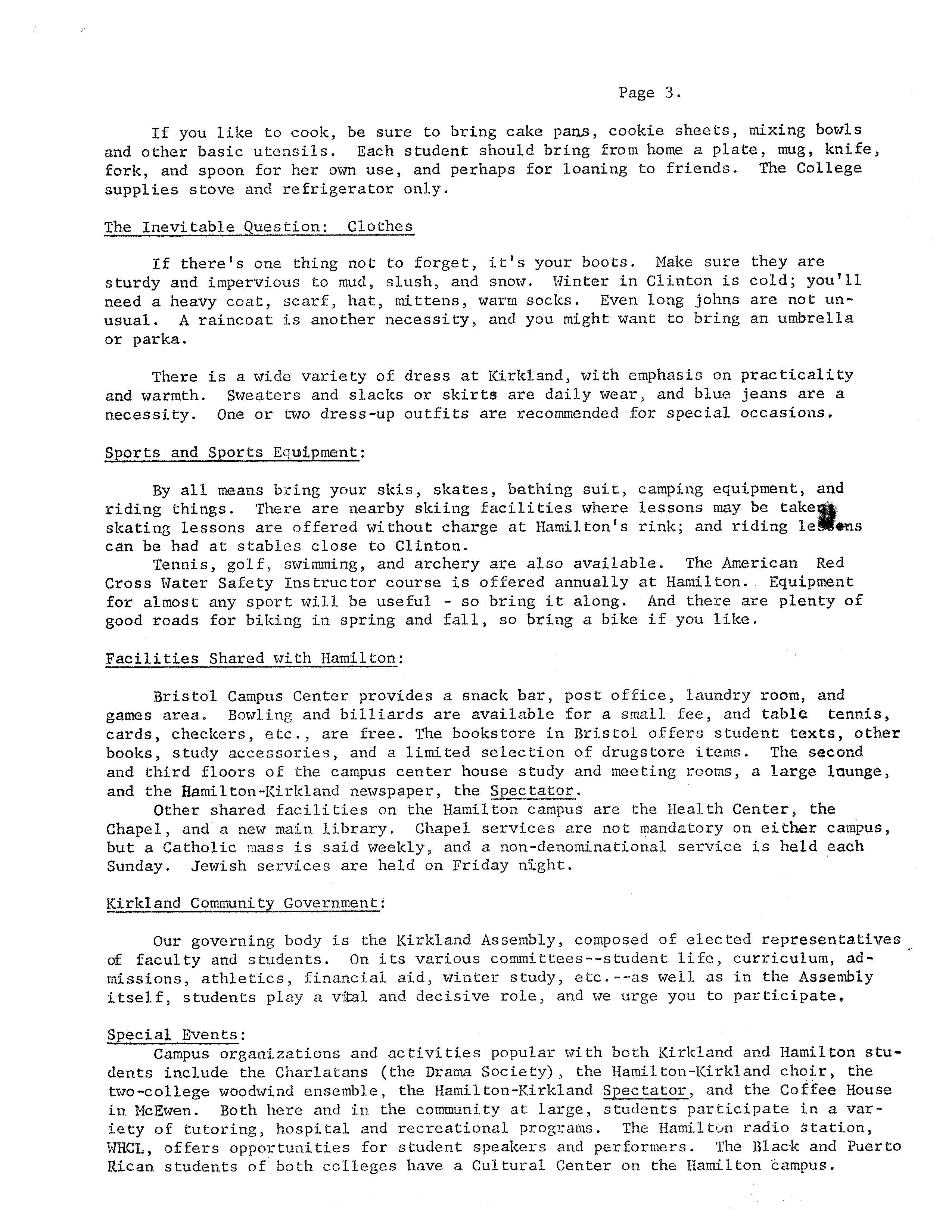
This summer, many Kirkland mothers are anxiously getting their own children ready for college. Some of their offspring, in fact, will be attending Hamilton in the fall. Here’s a set of instructions that incoming Kirkland freshwomen received in June 1974 before arriving on the Hill for their first semester. Look at the checklist of items in What to Bring (the cross outs are mine from 1974!).
Are you ready?
From Kirkland College to the Bard

Photos from Melissa Stern's Senior Project, a two-person play about a Marilyn Monroe-type starlet played by Melissa and her alter ego, a bitchy nun
At Kirkland, I was intensely involved in theater and did many shows with Carol Bellini-Sharp, who is still there on the Hill!! I met with her when I took my son for an interview at Hamilton last winter, and she had hardly changed at all. She was very welcoming, and I enjoyed meeting with her current crop of theater majors. Anyway, I also was in plays by Hamilton’s Harry Kondoleon, a brilliant and successful playwright who passed away far too early in the AIDS epidemic of the ’80s (http://harrykondoleon.com/wordpress/). And my senior project with my dear friend Marybeth Lerner, a performance of The White Whore and the Bit Player by Tom Eyen, was another high point of my time at Kirkland.
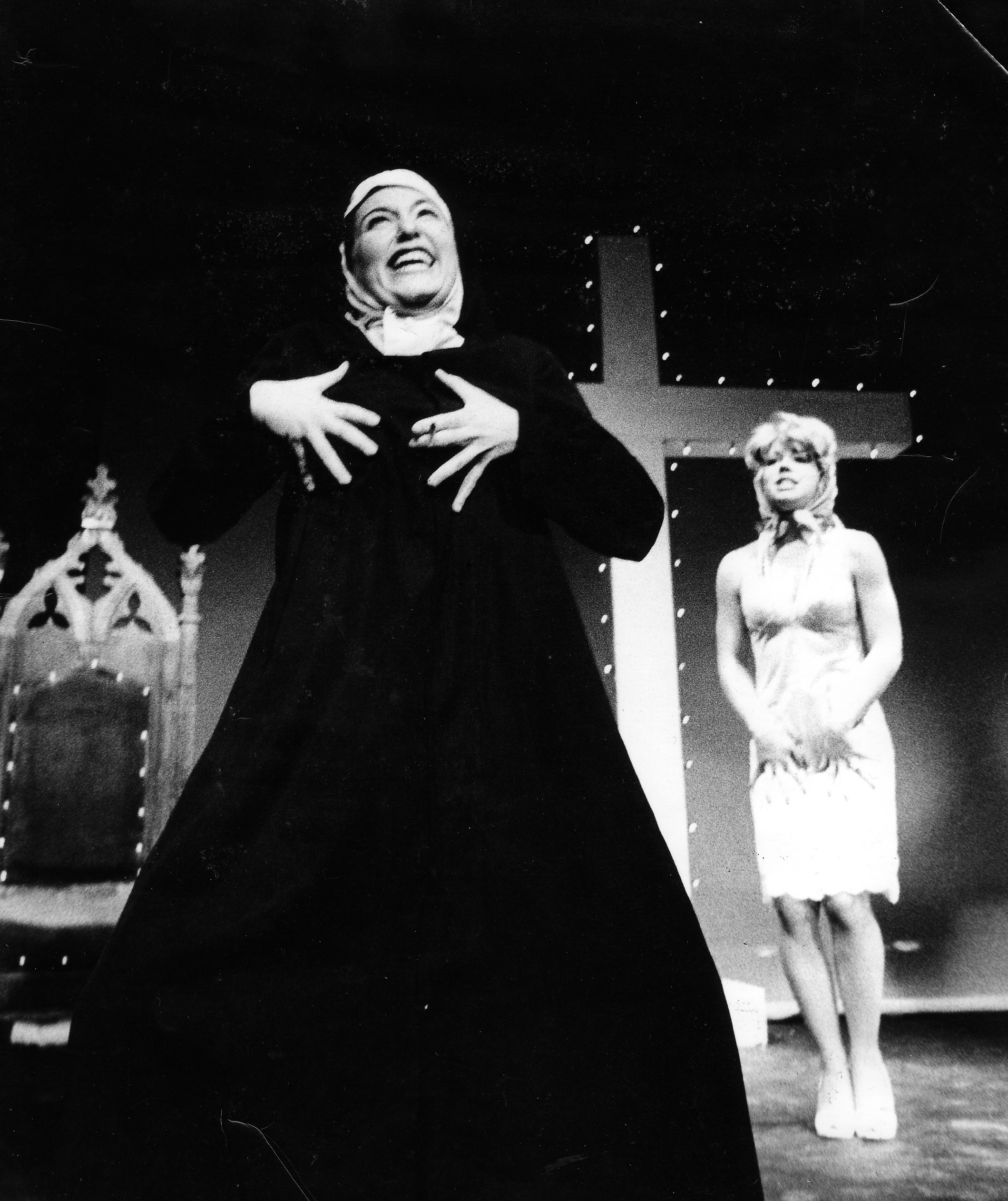
Marybeth Lerner as the nun
After Kirkland, I went to Paris and studied theater with Yoshi Oida, a member of Peter Brook’s famous theater group, whom I had met through a workshop recommended by Carol. I later got a Master’s of Fine Arts at American Conservatory Theater in San Francisco and did a bunch of regional theater out west. After several years of living in Los Angeles and doing theater there, I decided to head back to NYC. Shortly after that, I moved up to Garrison, NY, right near Cold Spring because I had met a guy who lived there and got married.
I was missing the theater and all my actor friends, so, when a woman named Nicky Balter, whom I had met through the Garrison Art Center (http://www.garrisonartcenter.org/), suggested that I stage a play up at Manitoga, a nature preserve in Garrison (http://www.russelwrightcenter.org/redesign/home.html), I was game. I contacted my friend Terry O’Brien, a classmate from ACT, and we produced A Midsummer Night’s Dream using the talents of a bunch of former ACT actors who had a group in Manhattan called the 29th Street Project. Terry directed, I played Hermia, and we rehearsed in the Lower East Side, finally bringing the show up to the wild woods of Manitoga and performing out in the rain for a couple of weekends.
The show managed to create a lot of enthusiasm among the artistic and cultural elite of the area. A Board of Directors was soon formed, and a company, Hudson Valley Shakespeare Festival, was created. I was the Producing Director, and Terry was the Artistic Director. The following year, we moved our operation to the lovely grounds of Boscobel, a Federal-style mansion on the banks of the Hudson River (http://www.boscobel.org/). Boscobel had ample parking and a large lawn where we could locate a tent. We did As You Like It the second year and from there, things started growing very fast.

Melissa Lourie, 2011
There were no other Shakespeare festivals in the Hudson Valley, and we seemed to fill a void. And our approach was fresh and lively and very accessible. I acted some but was more the business and producing head of the company, which proved pretty challenging, as we were also producing children at the time. My husband Peter and I had two kids during these years and in the beginning were also selling tickets out of our home and doing everything else, and it got pretty crazy. After 6 years I decided I’d had enough. Producing is a very exciting challenge, but it wasn’t what I was really in theater to do. So, I found myself a replacement, and we moved to Vermont. Up here in Vermont, I have found a satisfying balance of acting, directing, (http://middleburyactors.org/) teaching at UVM, and just plain living. It’s a great state and I wouldn’t trade it for anywhere else.
Gone—But Not Forgotten
 The institution of Kirkland College ceased to exist in 1978; however, for three decades her influence has been felt keenly on the Hill. From our professors and our curriculum to our very buildings—there are reminders everywhere of Kirkland’s undeniable legacy.
Some Kirkland traditions have been carried over to Hamilton’s commencement festivities. Many Kirkland graduates received a parting gift—mine in 1978 was a white-and-gold apple stick pin. Today, Professor Nancy Rabinowitz purchases and distributes green apple pins to graduating Hamilton women.
In the first post-merger graduation in 1979, former Kirkland students presented Hamilton’s President J. Martin Carovano with Granny Smith apples as a gesture of silent protest. Today, the Womyn’s Center (created by Kirkland students!) provides Hamilton women with Granny Smith apples in our memory. (http://kirklandalums.org/2011/05/13/graduation-kirkland-style/)
Take a look at this slideshow for small yet visible ways in which Kirkland was commemorated at the 2011 Hamilton College graduation. Look for the green apple pins and the real apples!
http://www.flickr.com/photos/hamiltoncollege/sets/72157626786323400/show/
 Kirkland College