Make Way for Ducklings
My Hamilton boyfriend seemed fascinated as I explained the concept of imprinting, following a Social Psych class with Dru Sherrod. It was an idea he could not shake.
It was early spring in 1977, on one of our spring jaunts to the hardware store in Clinton, when the owner shared he was also a gentleman farmer with some acreage in Clinton. He also shared information about someone selling ducklings.
Early one evening, I was told we were off on a search for a special Easter present. Driving those hilly back roads, we arrived at a farm on the outskirts of Oneida County. The peeps and quacks were unmistakable as we walked into the barn. That was the night I became a surrogate mother to six baby ducks.
I was smitten by their downiness and how tiny they seemed. Within a very short time, they formed a strong attachment and I became completely engrossed in their care and feeding. We journaled about their fascinating behavior, discussing the attachment process with friends and my professor. As this was Kirkland, the ducks offered another opportunity for informal learning outside the classroom walls. It was quite an experience watching them waddle around, explore the world and form a tight association with people. For months, we were captivated and charmed by these tiny suite mates.
I recall only three of the names- Puddle (who had one gray eye and one blue, and was very clever) Chester and Rutherford. They’d jump up and down in their box each morning, grab a few strands of my hair and start quacking. Sometimes, they’d overturn their bowl of corn, dragging it across their cage. That was hard work! At other times, they followed me around outside, near the back part of “B” Dorm (though I kept a watch for salivating retrievers) and also around the suite. I recall being impressed with how social, interactive and beguiling they were.
As the semester drew to a close, I was perplexed about taking them on the long drive home. I sought the advice of our farmer friend who invited me for a visit. He had an idyllic parcel of land with a fairly large pond (as opposed to the wading pool I used on campus for my brood). We agreed it would be heavenly for those ducks, though leaving them in Clinton was a bit heartbreaking. Yet when I returned to campus the next fall, I could clearly see they had adapted to their new digs. The ducks never seemed to forget me, cocking their fluffy heads and quacking up a storm when I visited. They also seemed to enjoy sleeping in a barn and marching down to the pond for a swim. Puddle had been born with a malformed leg, but maneuvered easily around his new home and his adolescent peep soon morphed into a resounding and more-deeply pitched “quack”.
One unexpected outcome of duck ownership was the kindly camaraderie with the farmer from town, who continued to dole out good advice when I visited the hardware store.
The ducklings are a memory I closely associate with college, sometimes with the ducklings in tow. I enjoyed watching them change the timber of their “peeps”, grow bigger wings and attempt flight and develop distinctive personalities.
But then, animals always seemed to be a memorable part of the Kirkland College experience.
Women’s Energy Weekend: April 1977
Women’s Energy Weekend was born in April 1977 at Kirkland College. A group of students, staff, and faculty collaborated on an event “to talk about, learn about and celebrate our experiences as women.”
Spanning three days from April 15 to 17, the inaugural WEW featured open-mike performances by women poets and musicians, a dance with the campus band “New Breed,” two theater pieces, a picnic, and discussions led by faculty and students or off-campus guests as follows:
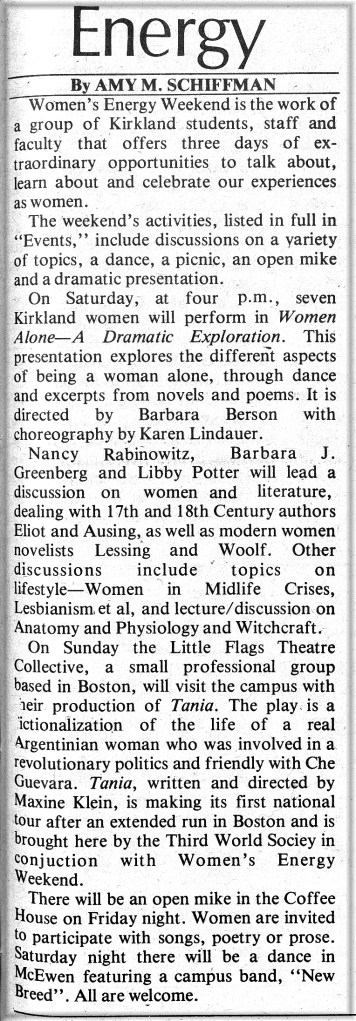
Spectator Article, Apr. 15 1977 , p.7
• Women and Literature
• Women and Law
• Lesbianism
• Anatomy and Physiology of the Human Female
• Witchcraft
• Women and Religion
What I remember is the climate, the atmosphere from which WEW formed and eventually flourished. Exploring what it meant to be a woman–physically, psychosocially, sexually–all that was being articulated openly, in various ways, and it felt very new. And of course, being at a fine arts school for women was in a way its own celebration of that. So all of us were on the same page, no matter how different we were from each other, and when I think back on it, we were all so different–in terms of backgrounds, sexual orientation. But it didn’t feel that way.
When I created Woman Alone, which was a collection of readings from women writers loosely woven into a dramatic narrative, it was extremely well attended, and not just by Kirkland women, but women from the community as well. I remember a woman coming up to me after a performance, who was practically in tears, and she told me how great she thought it was. She couldn’t believe it was put together by an 18-year-old! But I could see that she was touched by these women’s voices and perspectives. And that’s what I remember most.
by Barbara Berson ’79 with Jo Pitkin K’78
| Did You Know?
Kirkland’s Women’s Energy Weekend was the forerunner of today’s Womyn’s Energy Week held annually in April at Hamilton College. The current WEW is organized by Hamilton’s Womyn’s Center. The original Women’s Resource Center, founded at Kirkland by Cassandra Harris-Lockwood (K’74) and other students, was variously located in Kirner-Johnson or McEwen. Staffed by Kirkland students, the Center provided change for vending machines and washers and dryers, sold tampons, and offered information on feminism, rape, bodily image, lesbianism, abortion, and gynecological services. |
Second WEW, April 1978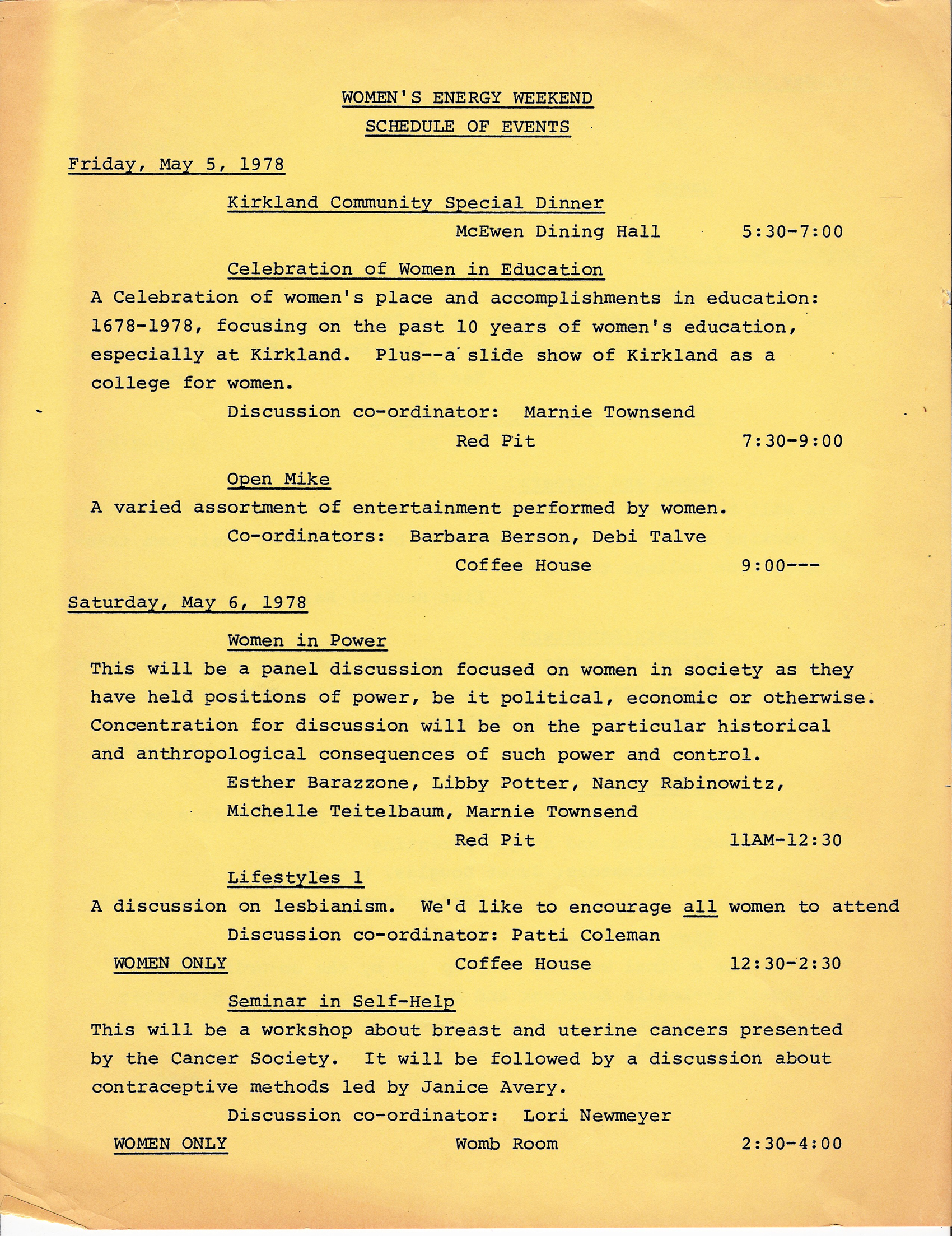 |
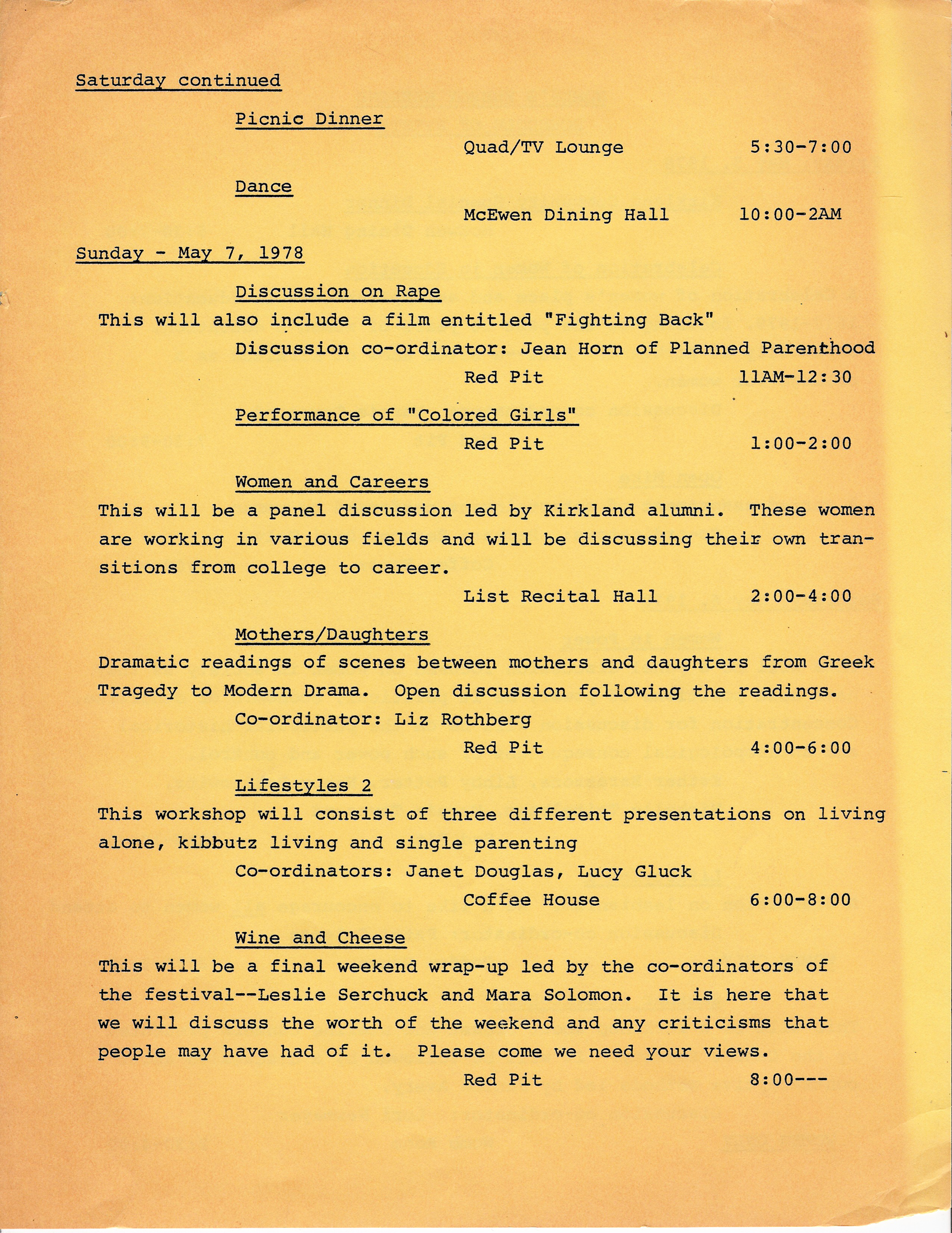 Program donated to Kirkland Archives by Katie Koelle, K'78 (click on image for full size) |
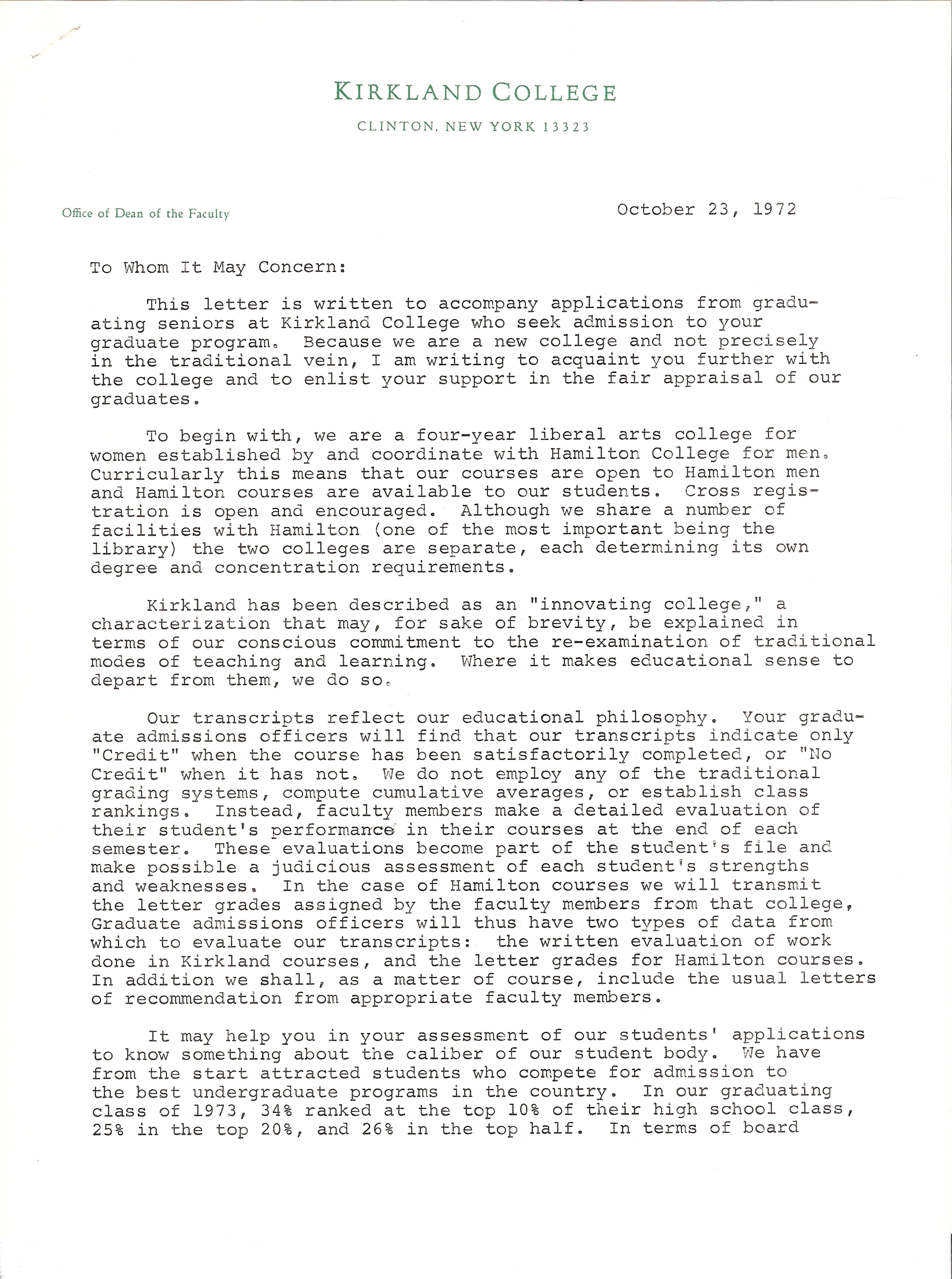
Evaluations
A, B, C, D, F.
Most college students are familiar with traditional letter grades. Kirkland’s students, however, received typed narrative evaluations for each course or independent study.
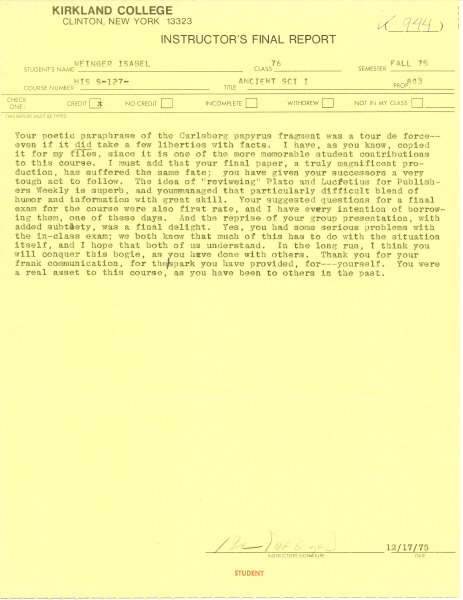
Contributed by Isabel Weinger-Nielsen K'76 (click on image for full size)
According to the 1976-1977 Particulars catalog, “Evaluations are personal, written statements from each professor, describing in detail your strengths and weaknesses in the course, your intellectual growth, and how you responded to the demands of the course.”
Kirkland’s use of evaluations removed grade-driven competition and fostered collaborative learning. Offering constructive feedback, evaluations often served as a useful blueprint for students’ future academic pursuits.
Other alternative colleges, like Kirkland, have used written evaluations as the sole assessment of a student’s work. These included Goddard, Hampshire, Evergreen State, and New College of Florida.
|
Did You Know? Written evaluations had to be “translated” into letter grades for some graduate school applications. This did not hold Kirkland students back. Alumnae from the graduating classes of 1971 through 1981 have received more than 780 graduate degrees—everything from a PhD, MD, MA, and MFA to a JD, MBA, MSW, and MS—including doctorates in divinity, dentistry, veterinary medicine, philosophy, education, and psychology. |
 |
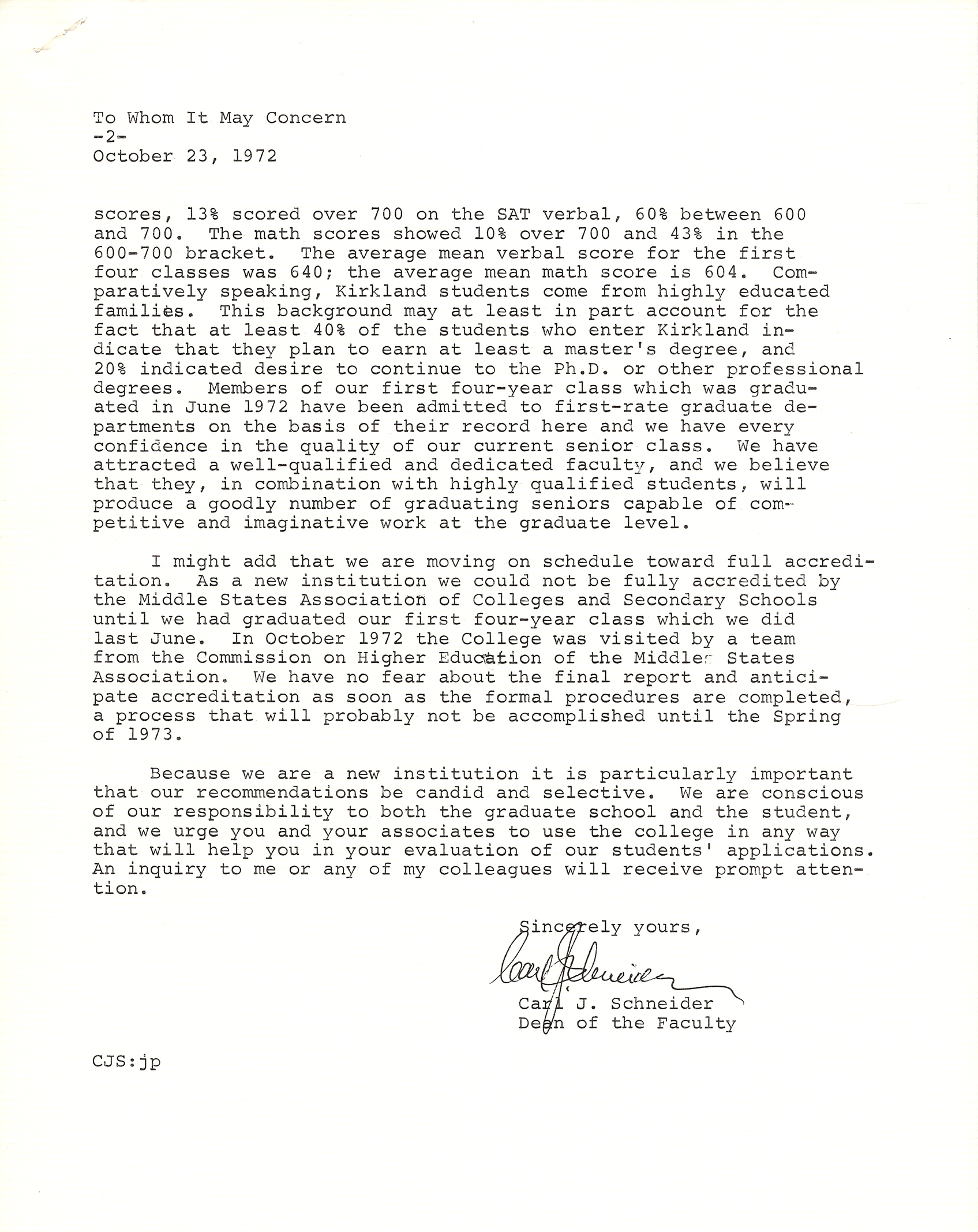 Letter on translating evaluations, Courtesy Katherine Collett, Hamilton Archivist |
by Jo Pitkin K’78
Sturbridge Ring-a-Round Playhouse

Ring-a-Round Playhouse playbill contributed by Liz Horwitt
Sturbridge Ring-a-Round Playhouse (aka “The Rounders”) was a summer stock company that lasted two seasons, ’71 and ’72, as far as I can remember. It was directed by Bob Harper, who taught drama at Kirkland. There were about two dozen of us, Hamilton and Kirkland both, stuffed into an old rambling house, five or six to a room. The second year, we had a different house and the guys slept in the attic with the bats. John Gillick, who was technical director, and very fond of guns, went up and shot at the bats with a rifle, which didn’t kill a single bat but probably didn’t do the ceiling any good.
The first year, Sturbridge let us use their Town Hall, but we messed it pretty good (holes in the floor, etc.) so we got kicked out and had to use the Southbridge Y the following year. We did a show a week, so quite often we actors wound up rehearsing for one play while performing in another. With just a week to get our lines, occasional fluffs did happen. I recall desperately improvising while playing cats cradle, waiting for the other actress to remember her lines. During I Am a Camera, (I played Fraulein Schneider, the crusty landlady) I spent a very tense five minutes deploying a carpet sweeper and muttering to myself in a German accent while Sally Bowles rushed backstage to find out what the hell had happened to Fritz’s entrance.

We did a very eclectic mix of plays, including Shaw’s You Never Can Tell, Anouilh’s Thieves’ Carnival, Dames at Sea, The Lady From Maxim’s, The Knack, and Rosencrantz and Guildenstern Are Dead. We also got stoned a lot – Bob Harper discovered a bunch of us standing in a circle and shaking our hands and giggling, and was extremely nonplussed. We got paid $20 a week plus room and board – not bad.
I just found a couple of letters I wrote from Sturbridge to my mother, the first summer. Here are a few excerpts:
Dear Mom,
I am writing this during a line rehearsal in the long spaces in between my lines. The play goes on tomorrow night and we don’t even have our lines down. I suppose this is the famed excitement and flurry of summer stock.
Last night was the last performance of The Knack. After the play the company was scattered all over the house, so I wandered around, playing a game of table hockey here, “Metaphors” there, kibbitzing on a chess game, listening to a guitar-playing session, getting my fortune told. . .
In a second letter:
As a company, we are going through another of our climbing-the-wall times. Tempers are short, and laughter tends to get a little hysterical. People fall into moods and cope with it in various ways that often gridge others.
Juno and the Paycock’s opening night went very well, I think. We haven’t seen reviews yet but Mr. Harper said I made him cry. For the first time in four weeks I don’t have a play to rehearse and I am on kitchen duty, washing dishes and cooking for our family is nothing compared to doing it for twenty-four people!
And to a friend, the following summer:
The first weeks in Sturbridge (Southbridge actually) are always a circus with everyone has been running around trying to learn the part/build the set/sew the costumes/fix up the theater before opening night (Dames at Sea). That was tonight, and I suppose, objectively, it was hilarious. Zivia’s dress parted from the rear up and her a belt popped of so she had to play the big romantic dance number with one hand clutching her rear, holding the dress closed. One love song sounded like cats moaning in a back alley. . .
I spent the week doing tech, living on ham and cheese sandwiches and not enough sleep. I spent two days arranging bricks on a flat so some of them would fall out in chunks when punched. I spent an entire afternoon trying to construct a star geometrically (so much for high school math).
by Elisabeth Horwitt K’73
 Kirkland College